What Airbnb Hosts in Europe Actually Keep in 2026: Fees, Tax and Rules in All 27 Countries
Fees, VAT, registration, night caps and tax in all 27 EU countries: what the platforms and the state take, and what to do before December 31.

By MagicBNB, EU Short-Term Rental Report 2026, version 1.0, updated
Why we wrote this. If you host in the EU, the answers you need in 2026 are scattered: fee tables that cover six countries, tourist-tax lists written for travellers, and guides that still quote Airbnb's old 3% fee. In one year the fee model changed, VAT moved in Spain and the Netherlands, and new registers and caps arrived from Vienna to Dublin. This study puts all 27 countries on one page, built from the numbers up: every figure carries a named source and a date, and every gap is labelled instead of filled. Start with the effective fee in Part 2 and the checklist in Part 9.
Key findings: the EU short-term rental market in 2026
The EU short-term rental market grew to 951.6 million platform guest nights in 2025, but in 2026 growth slowed, prices replaced volume, and Airbnb moved EU hosts to a 15.5% fee plus VAT. The five findings below each carry one number, its scope, its source and its date.
- Finding 1
951.6m
guest nights in 2025
EU platform guest nights rose 11.4% in 2025, but growth fell from 17.6% in Q2 2025 to 5.3% in Q2 2026.
Eurostat tour_ce_omr, pulled November 17, 2026
Read the evidence - Finding 2
+8.8%
average daily rate, October 2026
In October 2026, Europe's demand nights fell 1.7%, the 12th month without growth, while the average daily rate rose 8.8% and RevPAR 7.2%.
AirDNA, published November 10, 2026
Read the evidence - Finding 3
18.14% to 19.69%
real Airbnb fee in the EU
Since October 13, 2026, non-VAT-registered EEA hosts pay 15.5% plus VAT on the fee: €181 to €197 of every €1,000 booking.
Airbnb Help Centre; EC VAT table; MagicBNB calculation, November 17, 2026
Read the evidence - Finding 4
€4,460
fee error in a widely cited example
A Malaga comparison built on a 3% Airbnb fee understates fees by €4,460 on €30,104. At 18.8%, Spain's rounded rate, long-term letting wins.
Buvivo example, re-run by MagicBNB, November 2026
Read the evidence - Finding 5
95.9%
break-even occupancy, mortgage plus manager
A two-bed city flat with a €250,000 mortgage and a 20% manager needs 95.9% occupancy to break even. Europe averages 54.3%.
MagicBNB model; AirDNA October 2026
Read the evidence
What to do this week
Five actions are due or worth doing in the week of November 17, 2026: check your Airbnb payout wording, fix your guest-ID rules before November 20, prepare Spanish IVA registration, plan Irish registration and start your DAC7 reconciliation. Each item names its date and the country it applies to.
- 1Spain, France, Italy · Before November 20, 2026State the guest-ID law in your listing's additional rules before Airbnb's new house rules start, so you can keep collecting what the law requires. Details
- 2All EU · NowOpen one post-switch Airbnb payout breakdown and check whether it says "15.5% + VAT" or "VAT inclusive", then reprice with the gross-up for your country. Details
- 3Spain · Before December 1, 2026Ask your gestor about Modelo 036 registration before the first invoice taxed at 10% IVA, and how you will collect the tax. Details
- 4Ireland · December 1 to 31, 2026Register each unit with Failte Ireland (€25 per unit) as soon as the register opens; listing without a number is illegal from January 1, 2027. Details
- 5All EU · Before January 31, 2027Reconcile each platform statement against bank deposits and your tax return, because platforms report your 2026 income net of fees under DAC7. Details
General information, not legal or tax advice.
How big is the EU short-term rental market in 2026? 951.6 million guest nights
Guests spent 951.6 million nights in EU short-term rentals booked through Airbnb, Booking.com and Expedia in 2025, up 11.4% on 2024, but growth slowed to 5.3% by Q2 2026 (Eurostat, tour_ce_omr). Europe now earns more from fewer nights, because rates are rising while demand stalls.
What changed for EU hosts in 2026?
In 2026, 16 dated changes moved EU host economics in the same direction: Airbnb's 15.5% host-only fee from October 13, Spain's 10% IVA from December 1, night caps cut in Amsterdam and Zandvoort, new registers in Vienna and Ireland, and higher VAT in the Netherlands. The table lists each change with its money impact.
Fees, tax, caps, cancellations and heating costs all moved against the host in the same year, while the market still grew in revenue because prices rose faster than nights fell. Hosts who keep their margin are the ones who reprice, register and read the fine print.
Table 1. 2026 in 16 dated changes for EU hosts
Dates in 2026; money impact as reported in the cited sources.
| Date | What changed | Money impact |
|---|---|---|
| January 1, 2026 | Netherlands lodging VAT (BTW) rose from 9% to 21% | Highest accommodation VAT in the EU; a €200 Amsterdam night in 2027 carries about €74 of tax before any platform fee |
| January 1, 2026 | Budapest District VI went to zero nights; Bulgaria adopted the euro | About 2,700 District VI apartments lost STR income overnight; Bulgarian hosts now price and get paid in euro at 1.95583 lev per euro |
| February 1, 2026 | Lisbon cancelled 6,765 AL (Alojamento Local) registrations, 36.5% of the register, for missing insurance proof | 11,779 active registrations left; nationally 10,324 cancellations by June 2026 |
| February 2, 2026 | Spain's February sweep notified 86,275 illegal listings to platforms | Confirmed by the housing ministry (MIVAU) press release; the 200,000-plus total delistings figure often quoted alongside it is NOT verified and this study does not publish it |
| April 1, 2026 | Amsterdam cut the cap to 15 nights in 8 central neighbourhoods | Halves the legal ceiling for affected home-sharers; a €350 a night flat drops from about €9,000 gross to about €4,500 |
| May 20, 2026 | Regulation (EU) 2024/1028 began to apply | Platforms must verify and display registration numbers and transmit activity data monthly where a scheme exists; it creates no EU licence and no EU-wide cap |
| May 2026 | Spain's national register annulled (Supreme Court ruling STS 620/2026) | Regional codes (VUT, HUT, VV, VT) are the binding layer again |
| October 13, 2026 | Airbnb moved EEA hosts to the 15.5% host-only fee, plus VAT on top | Effective fee 18.14% to 19.69% for non-VAT-registered hosts |
| October 20, 2026 | Vienna passed its register law (WKVRG); promulgated November 9, 2026, in force November 10, 2026 | Registration mandatory for new listings from January 1, 2027, existing listings by April 1, 2027; fines up to €50,000 per violation |
| October 22, 2026 | Court of Justice of the EU (CJEU) ruled in Smartflats (C-813/24) | The EU Services Directive applies to city STR restrictions |
| October 28, 2026 | Dutch TTF gas passed €100/MWh, first time since December 2022 | Heating alone costs about €5 to €10 per booked winter night |
| October 29, 2026 | Vrbo moved to a flat 12% commission (12% to 15% in Europe) | Up from 5% for property management system (PMS) hosts and about 8% for others |
| November 6, 2026 | Poland's Senate adopted the CWTON act (central register of tourist accommodation) with 18 amendments: 93 for, 0 against, 1 abstention | Back in the Sejm, then the President; earliest entry end of December 2026 or early January 2027 |
| November 12, 2026 | Amsterdam council adopted the 2027 budget with tourist tax at 16% | From January 1, 2027, the most expensive tourist tax in Europe for a mid-range stay |
| November 20, 2026 | Airbnb's new house rules take effect | Hosts may not require checkout chores a cleaner would do, and may not solicit guest ID documents, phone numbers or email addresses |
| December 1, 2026 | Spain's 10% IVA on short holiday lets starts; Ireland's Failte Ireland register opens; Booking.com adds 24% VAT to commission in Greece | Three changes on one day; see the deadline calendar |
Source: MagicBNB country research, verified November 17, 2026. Verified, secondary source. Data as of November 17, 2026. Download CSV
How big is the market by country? Three countries take 56.8%
France, Spain and Italy took 56.8% of the 951.6 million EU platform guest nights in 2025, and the top 8 countries took 83.8% (Eurostat). Every EU country grew in 2025, led by Malta (up 34.4%) and Cyprus (up 24.7%), but quarterly growth fell from 17.6% to 5.3% within a year.
Guests spent 951.6 million nights in EU short-term rentals booked through Airbnb, Booking.com and Expedia in 2025, up 11.4% on 2024 and up 85.9% on 2019 (Eurostat dataset tour_ce_omr, pulled November 17, 2026).
Eurostat's platform dataset (tour_ce_omr) is the only official, harmonised measure of this market. It counts guest nights (people multiplied by nights) in short-stay accommodation booked through Airbnb, Booking.com and Expedia. It excludes hotels, campsites, direct bookings and smaller platforms. Tripadvisor left the segment in late 2024, so 2025 is the first three-platform year, which makes the 11.4% growth stronger than it looks.
2020 to 2022 are published rounded to millions. 2025 is the first year with three platforms.
Source: Eurostat, dataset tour_ce_omr (pulled November 17, 2026). MagicBNB analysis · magicbnb.io/blog/eu-short-term-rental-market-2026
Table 2. EU platform guest nights, 2019 to 2025
Million guest nights (people x nights), Airbnb, Booking.com and Expedia; 2020 to 2022 published rounded to millions.
| Year | Guest nights (millions) | Note |
|---|---|---|
| 2019 | 511.9 | Pre-pandemic peak |
| 2020 | 272 | Pandemic collapse |
| 2021 | 364 | Recovery |
| 2022 | 597 | Recovery |
| 2023 | 719.0 | |
| 2024 | 854.1 | Up 18.8% vs 2023 |
| 2025 | 951.6 | Up 11.4% vs 2024, up 85.9% vs 2019 |
Source: Eurostat, dataset tour_ce_omr (pulled November 17, 2026). Verified, primary source. Data as of November 17, 2026. Download CSV
2025 also produced 85.4 million stays and 321.8 million unit-nights (nights a property was occupied, whatever the party size): 234,092 stays every day. International guests accounted for 62.2% of guest nights (591.7 million). In 8 of the 31 EU and EFTA countries covered, international guests took more than 90% of platform nights.
France, Spain and Italy took 56.8% of all EU short-term rental platform guest nights in 2025, and the top 8 countries took 83.8% (Eurostat tour_ce_omr, 2025 data).
The remaining 19 member states combined take 16.2%. Every EU country grew in 2025. The fastest growers were Malta (up 34.4%) and Cyprus (up 24.7%) from small bases, then Greece (up 14.9%), Sweden (up 14.3%), and Poland and Czechia (up 13.8% each).
- France, Spain, Italy
- Ranks 4 to 10
- Other 17 countries (MagicBNB arithmetic)
Top 5: 69.5% · Top 8: 83.8% of EU platform guest nights.
Source: Eurostat tour_ce_omr, 2025 (pulled November 17, 2026); "Other 17" is MagicBNB arithmetic. MagicBNB analysis · magicbnb.io/blog/eu-short-term-rental-market-2026
Table 3. Guest nights by country, 2025 and Q2 2026
Million platform guest nights; growth year on year. Q2 2026 is shown only for the 19 countries verified against the Eurostat API.
| Rank | Country | Guest nights 2025 (m) | Share of EU 2025 | 2025 vs 2024 | Guest nights Q2 2026 (m) | Q2 2026 vs Q2 2025 |
|---|---|---|---|---|---|---|
| 1 | France | 212.6 | 22.3% | +10.5% | 56.0 | +6.2% |
| 2 | Spain | 189.5 | 19.9% | +11.1% | 48.9 | +1.9% |
| 3 | Italy | 138.7 | 14.6% | +9.5% | 42.9 | +8.1% |
| 4 | Germany | 68.3 | 7.2% | +13.0% | 20.3 | +6.5% |
| 5 | Greece | 52.1 | 5.5% | +14.9% | 14.6 | +8.3% |
| 6 | Portugal | 49.5 | 5.2% | +10.3% | 14.0 | +2.6% |
| 7 | Poland | 44.4 | 4.7% | +13.8% | 11.5 | +8.9% |
| 8 | Croatia | 41.9 | 4.4% | +11.3% | 10.5 | +1.1% |
| 9 | Austria | 24.8 | 2.6% | +7.1% | 4.8 | −3.0% |
| 10 | Belgium | 13.4 | 1.4% | +9.4% | 3.9 | +3.1% |
| 11 | Hungary | 13.0 | 1.4% | +13.3% | 3.2 | −2.0% |
| 12 | Czechia | 12.2 | 1.3% | +13.8% | 3.4 | +9.3% |
| 13 | Netherlands | 11.9 | 1.3% | +5.4% | 3.8 | +2.3% |
| 14 | Romania | 10.4 | 1.1% | +12.6% | 2.6 | +11.4% |
| 15 | Sweden | 9.2 | 1.0% | +14.3% | 2.2 | +6.6% |
| 16 | Ireland | 8.4 | 0.9% | +13.2% | 2.6 | +6.5% |
| 17 | Denmark | 8.2 | 0.9% | +12.7% | 2.2 | +1.7% |
| 18 | Malta | 7.8 | 0.8% | +34.4% | 2.7 | +25.0% |
| 19 | Cyprus | 7.6 | 0.8% | +24.7% | 1.9 | −2.4% |
| 20 | Finland | 6.3 | 0.7% | Not computed here | Not verified | Not verified |
| 21 | Bulgaria | 5.0 | 0.5% | Not computed here | Not verified | Not verified |
| 22 | Slovenia | 4.5 | 0.5% | Not computed here | Not verified | Not verified |
| 23 | Slovakia | 4.4 | 0.5% | Not computed here | Not verified | Not verified |
| 24 | Lithuania | 2.7 | 0.3% | Not computed here | Not verified | Not verified |
| 25 | Latvia | 2.0 | 0.2% | Not computed here | Not verified | Not verified |
| 26 | Estonia | 1.9 | 0.2% | Not computed here | Not verified | Not verified |
| 27 | Luxembourg | 0.5 | 0.1% | Not computed here | Not verified | Not verified |
| EU27 total | 951.6 | 100% | +11.4% | 258.8 | +5.3% |
Source: Eurostat, dataset tour_ce_omr (pulled November 17, 2026). Verified, primary source. Data as of November 17, 2026. Germany: the Eurostat article text says 13.0% growth in 2025; the current dataset computes to 13.1%. This study uses the article figure. EU27 total 951.6 million (2025) and 258.8 million (Q2 2026, +5.3%). Download CSV
EU platform guest-night growth fell from 17.6% year on year in Q2 2025 to 5.3% in Q2 2026, when 258.8 million nights were booked (Eurostat tour_ce_omr, November 2026).
Quarterly growth fell from 17.6% (Q2 2025) to 9.8% (Q3 2025), 10.9% (Q4 2025), 9.7% (Q1 2026) and 5.3% (Q2 2026). The first half of 2026 totalled 403.1 million guest nights, up 6.9%. Spain's Q2 growth fell to 1.9% from 11.1% for full-year 2025, the clearest sign of the delisting effect in the official data. Austria (down 3.0%), Cyprus (down 2.4%) and Hungary (down 2.0%) shrank outright in Q2 2026, and Malta (up 25.0%) grew fastest.
- Spain
- Austria (shrank)
- Other top-8 countries
* Q3 2025: press coverage of the Eurostat release reports +8.7% (398.1 million nights). This study keeps +9.8% pending a re-check against the API.
H1 2026: 403.1 million nights, +6.9%. Q3 2026 data is expected in early January 2027.
Source: Eurostat tour_ce_omr (pulled November 17, 2026); Q3 2025 is flagged for re-check. MagicBNB analysis · magicbnb.io/blog/eu-short-term-rental-market-2026
Show the data
| Series | Q1 2026 or quarter | Q2 2026 |
|---|---|---|
| EU27 Q2 2025 | +17.6% | |
| EU27 Q3 2025 | +9.8% | |
| EU27 Q4 2025 | +10.9% | |
| EU27 Q1 2026 | +9.7% | |
| EU27 Q2 2026 | +5.3% | |
| Italy | +14.7% | +8.1% |
| Germany | +14.9% | +6.5% |
| Greece | +14.9% | +8.3% |
| Poland | +11.9% | +8.9% |
| France | +8.1% | +6.2% |
| Spain | +6.5% | +1.9% |
| Portugal | +4.9% | +2.6% |
| Austria | +4.0% | −3.0% |
The next Eurostat release, covering Q3 2026, is expected in early January 2027, following the January 8, 2026 release date for Q3 2025. That is an inference from the release pattern, not a published date (unverified: search snippet only). It will be the first read on whether the slowdown continued below 5.3%.
The concentration repeats at region and city level. The top 20 regions take 47.1% of EU platform guest nights. Andalucia alone took 50.3 million nights in 2025, followed by Jadranska Hrvatska (39.5 million) and Provence-Alpes-Cote d'Azur (33.5 million). The top cities are Paris (26.3 million), Rome (18.8 million), Barcelona (13.2 million), Madrid (12.3 million) and Lisbon (11.6 million).
Live Airbnb listings (AirROI, September 30, 2026) tell the same story from the supply side: France 581,000, Italy 273,000, Spain 214,000, Germany 110,000, Greece 83,200, Portugal 75,000, Croatia 57,400. Worldwide, AirROI counts about 4.9 million live Airbnb listings; Airbnb's own “9 million plus active” figure uses a different definition and should not be compared directly.
Is the European short-term rental market growing? Demand down 1.7%, rates up 8.8%
In October 2026, European short-term rental demand nights fell 1.7% year on year, the 12th straight month without growth, while average daily rate rose 8.8% to €131.18 and RevPAR rose 7.2% to €71.24 (AirDNA, published November 10, 2026). The market stopped growing in volume but kept growing in money.
In October 2026, European short-term rental demand nights fell 1.7% year on year while average daily rate rose 8.8% to €131.18 and RevPAR rose 7.2% to €71.24 (AirDNA European Short-Term Rental Market Review, published November 10, 2026).
European short-term rental occupancy was 54.3% in October 2026, down 0.8 points year on year (AirDNA, October 2026).
- Up
- Down
Occupancy: 54.3%, down 0.8 points (a change in points, so it is not drawn as a bar).
Same listings, same nights, 7.0% dearer: hosts raised prices. Spain: demand down 5.6%, ADR up 12.5%, RevPAR up 13.7%.
Source: AirDNA, European Short-Term Rental Market Review, October 2026 (published November 10, 2026). MagicBNB analysis · magicbnb.io/blog/eu-short-term-rental-market-2026
Table 4. Europe in October 2026: fewer nights, higher rates
Europe, October 2026 against October 2025. Occupancy change in percentage points.
| Metric, Europe | October 2026 | Year on year |
|---|---|---|
| Available listings | 3.79 million | +0.8% |
| Demand nights | 38.5 million | −1.7% (12th month without growth) |
| Average daily rate (ADR) | €131.18 | +8.8% |
| Occupancy | 54.3% | −0.8 points |
| Revenue per available night (RevPAR) | €71.24 | +7.2% |
| Repeat Rent Index (same listings, same nights) | Index | +7.0% |
Source: AirDNA, European Short-Term Rental Market Review, October 2026 (published November 10, 2026). Verified, secondary source. Data as of November 10, 2026. Download CSV
The Repeat Rent Index strips out mix effects: the same listings, on the same nights, charged 7.0% more. This is hosts raising prices, not better properties entering the market.
Spain is the extreme case. Spanish listings fell 5.9% and demand nights fell 5.6% (264,000 fewer nights, 39% of Europe's net decline), yet occupancy rose 0.6 points to 60.1%, ADR rose 12.5% and RevPAR rose 13.7%. Supply was removed faster than demand fell, so the survivors earn more. Six of the ten fastest ADR gains among Europe's 50 largest cities were Spanish: Madrid up 21.2%, Barcelona up 18.7%, Malaga up 16.5%, Marbella up 15.4%, Seville up 14.6% and Valencia up 14.2%. Budapest was third at 18.6% and Split fourth at 18.4%.
Germany went the other way: demand down 3.5% in October and down 6.5% over the summer while supply rose 2.7%. Poland's demand rose 11.4% in October.
One caution on listing counts: the trackers disagree. AirDNA shows EU capital listings down 22% to 58% year on year while revenue per listing is up 48% to 153%, which reads as a definitional change, not a real supply collapse. Airbtics shows the same cities up 19% to 49%. This study uses Eurostat for market size and AirDNA for monthly direction, and names the tracker every time a tracker number appears. For more on how the trackers differ, see our comparison of STR analytics tools.
Hotels confirm the price story. Paris hotels posted their highest monthly ADR on record in October 2026 (€474.64, up 13.5%) while short-term rental occupancy fell across Europe.
What is the EU short-term rental market worth?
The EU platform-only market is worth at least €39 billion a year on this study's bottom-up calculation from Eurostat nights and AirDNA rates. Phocuswright puts Europe at USD 79.7 billion in 2026 on a wider scope. The two figures measure different markets and should never be quoted as one number.
Phocuswright puts global short-term rental gross bookings at USD 219.9 billion in 2025, growing 5.3% a year to USD 270.6 billion by 2029, with Europe at USD 79.7 billion in 2026. This study's bottom-up calculation, built from Eurostat guest nights and AirDNA rates, puts the EU platform-only floor at about €39 billion to €42 billion.
The gap is mostly scope: direct bookings, smaller platforms and inventory Eurostat does not capture. The defensible statement is that the EU platform market is worth at least €39 billion a year, and the wider European short-term rental economy is worth considerably more.
When is high season? A third of the year in two months
July and August held 33.1% of all EU platform guest nights in 2025 (July 15.7%, August 17.5%), and 57% in Croatia (Eurostat). The average EU stay is 3.77 nights, and bookings are getting shorter and later: stays booked under 7 days ahead are now 26% of check-ins among professional managers.
July and August accounted for 33.1% of all EU platform guest nights in 2025, and 57% in Croatia (Eurostat tour_ce_omr, 2025).
Q3 alone is 42.3% of the year, while January, February, March and November each take about 4% to 5%. The summer peak is most extreme in Croatia (57%), Slovenia (45%), Sweden (44%) and Greece (43%), and flattest in Luxembourg (22%), Finland (23%) and Czechia, Austria and Belgium (25% each). If your pricing does not treat July and August as a different business, you are leaving money on the table.
- EU27
- Most and least seasonal countries
The study publishes only the most and least concentrated countries. A 12-month chart is not drawn because the monthly EU series was not pulled.
Source: Eurostat tour_ce_omr, 2025 (MagicBNB calculation from monthly data). MagicBNB analysis · magicbnb.io/blog/eu-short-term-rental-market-2026
Show the data
| Country | July and August share of 2025 nights |
|---|---|
| Croatia | 57% |
| Slovenia | 45% |
| Sweden | 44% |
| Greece | 43% |
| EU27 | 33.1% |
| Czechia | 25% |
| Austria | 25% |
| Belgium | 25% |
| Finland | 23% |
| Luxembourg | 22% |
The EU average stay is 3.77 nights with 2.96 guests. Island and southern beach markets stay longest (Malta 6.38 nights, Cyprus 5.64, Spain 4.64); central and eastern city-break markets stay shortest (Romania 2.50, Finland 2.75, Poland 2.76). The full table is in Appendix A.
Bookings are getting shorter and later. Among professional managers, short breaks of 1 to 5 nights are now two-thirds of bookings, while 6 to 8 night stays fell from 39% of bookings in 2023 to 27% in 2026. Bookings made under 7 days ahead are 26% of check-ins, up 8 points since 2023, and 82% of them come through Booking.com and Airbnb; they bring only 13% of revenue at an ADR of €120.00. Bookings made 180 or more days ahead are 11% of reservations but 22% of revenue, at an ADR of €247.32, and direct channels take 68.9% of those check-ins. (Key Data professional-manager data, reported at the Vacation Rental World Summit 2026 in Lyon and covered by NextPax. It describes professional managers, not all hosts.)
Channel mix in Europe on the same basis is Booking.com 48%, Airbnb 40%, direct 11% and Vrbo 2%. The US mix is very different: Airbnb 43%, direct 28%, Vrbo 28%, Booking.com 8%. Europe's 11% direct share is the opportunity Part 6 returns to.
Airbnb, Vrbo and Booking.com fees in Europe: the fee is not 15.5%
Since October 13, 2026, a non-VAT-registered Airbnb host in the EU pays an effective fee of 18.14% to 19.69%, because local VAT is added on top of the 15.5% host-only fee. Vrbo now charges 12% to 15%, Booking.com about 15% plus payments and VAT, and a direct card booking about 1.5%.
The headline number every host knows, 15.5%, is not the number any non-VAT-registered host in the EU actually pays. We found no other published guide with the effective fee for all 27 EU countries; the best we found, in English-language host guides searched in November 2026, covered six.
Airbnb fee by country: the real 15.5% plus VAT rate in all 27 EU countries
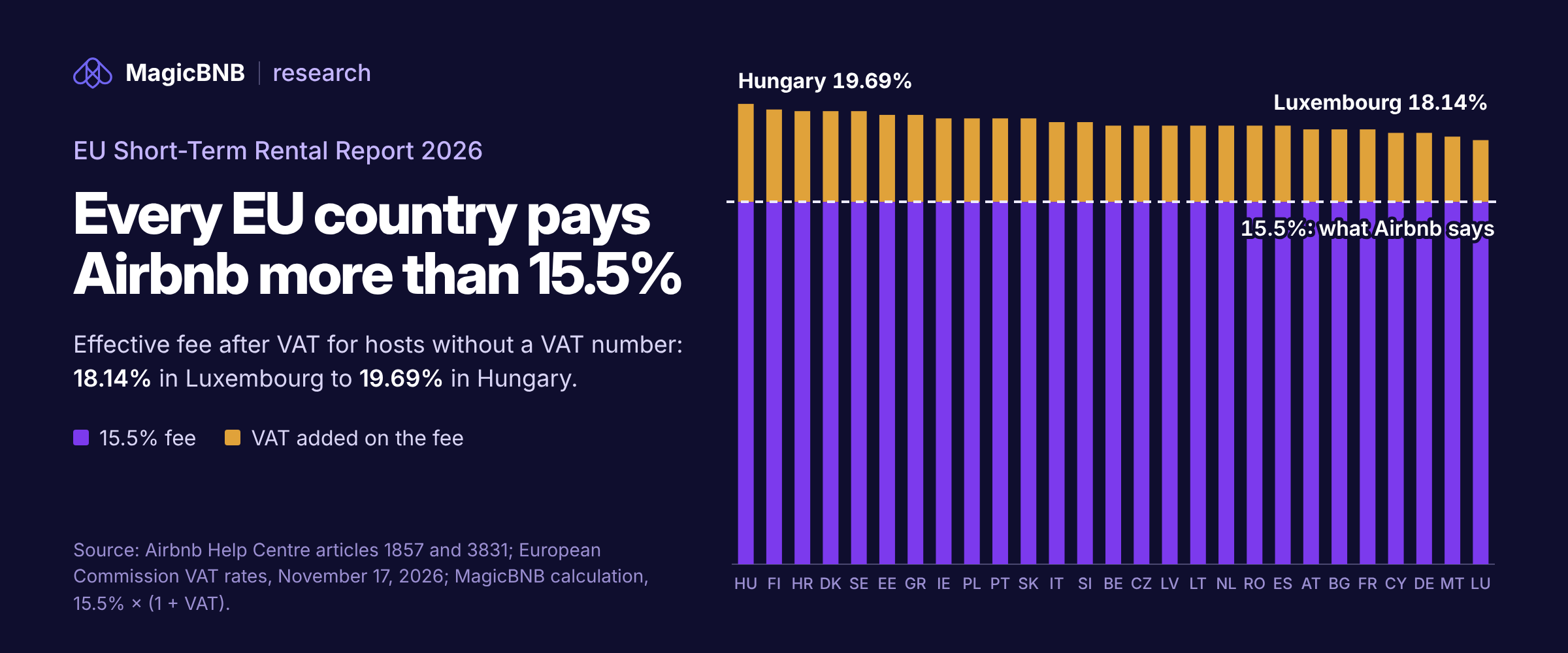
Airbnb's effective fee for a non-VAT-registered EU host is 15.5% multiplied by one plus the local standard VAT rate: 19.69% in Hungary, 18.14% in Luxembourg and about 18.9% on an unweighted EU average (Airbnb Help Centre articles 1857 and 3831; European Commission VAT table; MagicBNB calculation, November 17, 2026).
On October 13, 2026, Airbnb moved all remaining EEA and Swiss hosts to a 15.5% host-only service fee. US and Canada PMS hosts had moved on October 27, 2025, and the remaining non-EEA hosts on September 15, 2026. Under the old split-fee model, hosts paid 3% and guests paid the rest. Our earlier explainer covers the single 15.5% service fee.
Then VAT is charged on top of the fee. For a host without a VAT number, Airbnb adds local VAT to the 15.5%, so the effective fee is 15.5% multiplied by one plus the standard VAT rate.
Since October 13, 2026, a non-VAT-registered Airbnb host in Hungary pays an effective fee of 19.69% (Airbnb Help Centre; MagicBNB calculation).
Airbnb's own worked example, in its Resource Centre, settles the money. A host raises the price from USD 100 to USD 119. Airbnb takes a USD 17.83 fee (15.5% of USD 115) and USD 3.57 of VAT on the fee (20% of the fee), and the host is paid USD 97.60. The VAT is computed on top.
The display wording is not settled. Airbnb's fee page says the displayed fee “is VAT inclusive, where applicable”, while hosts report bookings showing “15.5% + VAT”. Open one post-switch price breakdown in your own account and check which wording your payouts use. The table below uses the VAT-on-top reading, which matches Airbnb's worked example.
Two traps sit in the detail. Airbnb Help article 3831, which lists the VAT Airbnb applies per country, still lists Estonia at 22%; Estonia's standard rate rose to 24% on July 1, 2025, so the correct effective fee is 19.22%, not 18.9%. The page says Airbnb does “not update this information in real time”, so Estonian hosts should check which rate their billing uses. And article 3831 has no Luxembourg entry; Luxembourg's 17% comes from the European Commission's VAT table.
Since October 13, 2026, a non-VAT-registered Airbnb host in the EU pays an effective fee of 18.14% (Luxembourg) to 19.69% (Hungary), about 18.9% on average, because local VAT is added on top of the 15.5% host-only fee (MagicBNB calculation from Airbnb Help Centre articles 1857 and 3831 and the European Commission VAT table, November 17, 2026).
- 15.5% host-only fee
- VAT on the fee
- 15.5% headline
- EU average about 18.9%
¹ Estonia: Airbnb's VAT list (article 3831) still shows 22%. The correct rate is 24% since July 1, 2025.
² Luxembourg: Not in Airbnb's VAT list; the 17% rate is from the European Commission table.
VAT-registered hosts pay a flat 15.5% (€155 per €1,000, keeping €845) in every country. Canary Islands: Airbnb applies 7% IGIC instead of VAT, so the effective fee there is 16.59%.
Source: Airbnb Help Centre articles 1857 and 3831; European Commission VAT rates (November 17, 2026); MagicBNB calculation, 15.5% x (1 + VAT). MagicBNB analysis · magicbnb.io/blog/eu-short-term-rental-market-2026
Table 5. Effective Airbnb fee by country, all 27 (non-VAT-registered host)
Percent of booking value and euro per €1,000 booking. Effective fee = 15.5% x (1 + standard VAT).
| Country | VAT on fee | Effective fee | Fee on €1,000 | Host keeps on €1,000 | Markup to hold old payout | Gross-up to receive full listed price |
|---|---|---|---|---|---|---|
| Hungary | 27% | 19.69% | €196.85 | €803.15 | +19.8% | +24.5% |
| Finland | 25.5% | 19.45% | €194.53 | €805.48 | +19.5% | +24.2% |
| Croatia | 25% | 19.38% | €193.75 | €806.25 | +19.4% | +24.0% |
| Denmark | 25% | 19.38% | €193.75 | €806.25 | +19.4% | +24.0% |
| Sweden | 25% | 19.38% | €193.75 | €806.25 | +19.4% | +24.0% |
| Estonia | 24% | 19.22% | €192.20 | €807.80 | +19.2% | +23.8% |
| Greece | 24% | 19.22% | €192.20 | €807.80 | +19.2% | +23.8% |
| Ireland | 23% | 19.07% | €190.65 | €809.35 | +19.0% | +23.6% |
| Poland | 23% | 19.07% | €190.65 | €809.35 | +19.0% | +23.6% |
| Portugal | 23% | 19.07% | €190.65 | €809.35 | +19.0% | +23.6% |
| Slovakia | 23% | 19.07% | €190.65 | €809.35 | +19.0% | +23.6% |
| Italy | 22% | 18.91% | €189.10 | €810.90 | +18.8% | +23.3% |
| Slovenia | 22% | 18.91% | €189.10 | €810.90 | +18.8% | +23.3% |
| Belgium | 21% | 18.76% | €187.55 | €812.45 | +18.6% | +23.1% |
| Czechia | 21% | 18.76% | €187.55 | €812.45 | +18.6% | +23.1% |
| Latvia | 21% | 18.76% | €187.55 | €812.45 | +18.6% | +23.1% |
| Lithuania | 21% | 18.76% | €187.55 | €812.45 | +18.6% | +23.1% |
| Netherlands | 21% | 18.76% | €187.55 | €812.45 | +18.6% | +23.1% |
| Romania | 21% | 18.76% | €187.55 | €812.45 | +18.6% | +23.1% |
| Spain | 21% | 18.76% | €187.55 | €812.45 | +18.6% | +23.1% |
| Austria | 20% | 18.60% | €186.00 | €814.00 | +18.4% | +22.9% |
| Bulgaria | 20% | 18.60% | €186.00 | €814.00 | +18.4% | +22.9% |
| France | 20% | 18.60% | €186.00 | €814.00 | +18.4% | +22.9% |
| Cyprus | 19% | 18.45% | €184.45 | €815.55 | +18.2% | +22.6% |
| Germany | 19% | 18.45% | €184.45 | €815.55 | +18.2% | +22.6% |
| Malta | 18% | 18.29% | €182.90 | €817.10 | +18.1% | +22.4% |
| Luxembourg | 17% | 18.14% | €181.35 | €818.65 | +17.9% | +22.2% |
Source: MagicBNB calculation: 15.5% x (1 + standard VAT), VAT from the European Commission table. Data as of November 17, 2026. VAT rates from the European Commission VAT table (opened November 17, 2026), cross-checked against Airbnb Help Centre article 3831. Markup columns use Rental Scale-Up's formulas: old-payout markup = (1 minus old effective fee) / (1 minus new effective fee), where the old effective fee is 3% x (1 + VAT); full-price gross-up = 1 / (1 minus new effective fee). Romania's standard VAT rose from 19% to 21% in August 2025. Canary Islands: Airbnb applies 7% IGIC instead of VAT, so the effective fee there is 16.59%. Download CSV
On a €1,000 booking, Airbnb takes €181.35 in Luxembourg and €196.85 in Hungary from a non-VAT-registered host after VAT on the fee (MagicBNB effective fee table, November 2026).
The spread is 1.55 points. On €60,000 of annual gross, a Hungarian host pays €11,811 in fee plus VAT and a Luxembourg host pays €10,881, a €930 a year difference for the same platform and the same bookings.
A VAT-registered Airbnb host in the EU pays a flat 15.5%, keeping €845 per €1,000, because they reverse-charge the VAT (Airbnb Help Centre; MagicBNB, November 2026).
The VAT that a non-VAT-registered host cannot recover costs €26.35 (Luxembourg) to €41.85 (Hungary) per €1,000 of bookings; on €60,000 of annual gross, that is €1,581 to €2,511 a year. Registering for VAT just to reclaim it usually backfires, because registration makes your own rental income VAT-liable. Rental Scale-Up works a UK example where a host would pay about GBP 10,000 in VAT on accommodation to reclaim GBP 1,860 on fees. Ireland is the exception on process, not on rate: Airbnb charges Irish hosts 23% VAT on the fee whether or not they are VAT-registered, and registered hosts recover it through their VAT return.
Italy stacks a second charge on top of the fee. Airbnb withholds 21% income tax as a substitute tax from non-professional hosts on stays up to 30 nights, on the gross amount before its fee, cleaning fee included.
On a €1,000 Airbnb booking in Italy, a non-professional host receives about €600.90 in cash after €189.10 of fee plus VAT and €210 of 21% withholding (MagicBNB arithmetic, November 2026).
A host with a second property owes a 5-point top-up at filing (26% cedolare secca against 21% withheld). The fee table alone understates what an Italian host actually receives in cash.
What does Vrbo charge in Europe? 12% to 15%, and not all-in
Vrbo moved hosts to a flat 12% commission on October 29, 2026, and hosts in Europe pay 12% to 15%, with the exact rate in the Owner Dashboard. For most hosts that is a rise of 4 points, and 7 points for PMS-connected hosts who paid 5%. Vrbo lists payment processing separately in its terms.
Vrbo moved hosts to a flat 12% commission on October 29, 2026, and hosts in Europe pay 12% to 15% (Vrbo host email of September 29, 2026 and Expedia Group FAQ).
The rate follows the booking date, not the stay date. Old rates were 5% for PMS-connected hosts and about 8% for others. To hold the same payout, a host moving from 8% to 12% must raise prices about 4.5%; a host moving from 5% to 12% must raise them about 8%.
Do not call 12% all-in. Vrbo's live Host Terms list commission and payment processing separately (clause 4.6.1), and a 3% processing fee still applies to taxes and refundable deposits in some configurations. The 12% figure itself does not appear in the terms text; it comes from Vrbo's September 29 host email and the Expedia FAQ. Vrbo does not publish a guest-fee range; trade press reports about 11% to 14%.
Two clauses cost money beyond the commission. Clause 4.5.7 is the rate-parity clause, which expressly includes “your own websites” in the live terms opened November 17, 2026 (see section 2.7). And the 30-day Lead rule (clause 4.8.1) says that if a guest contacts you through Vrbo and books direct within 30 days, Vrbo is owed commission, including on a substitute property, and you must self-report.
How much does Booking.com charge hosts in Europe? About 15% plus payments plus VAT
Booking.com charges 10% to 25% commission, about 15% typical, with no published rate card. Payments by Booking.com adds 1.1% to 3.1%, and VAT is added to the commission where the host has no VIES-valid VAT number, so the all-in cost runs from €161 to €217 per €1,000 of bookings.
Greece is the sharp end. From December 1, 2026, Greek partners without a VIES-valid VAT number get 24% VAT added to the commission invoice: at a 16.6% commission, the effective rate becomes 20.58%, so on a €1,000 booking the host keeps €794.16 instead of €834. (At the 15% commission plus 2.0% payments used in the channel table, the Greek host keeps €794.00.) The December 1 date and the 24% rate are Greece-specific; the mechanism, VAT on commission without a VIES-valid number, is EU-wide.
The add-ons stack. Preferred costs about 3 extra points and Preferred Plus about 8 extra points (reported, not published by Booking.com). Genius discounts are host-funded: Level 1 is 10%, Levels 2 and 3 add 15% and 20%. A host on Preferred Plus with Genius Level 3 can give away more than a third of the nightly rate before the guest arrives. Booking.com now collects payment on 74.7% of gross bookings, up from 71.8% a year earlier, so more hosts pay the payments fee whether they chose it or not.
What does a direct booking cost? €15.25 per €1,000
A direct booking paid by a standard EEA card through Stripe costs 1.5% plus €0.25: €15.25 per €1,000, so the host keeps €984.75. That compares with €794.00 to €815.55 kept on Airbnb and Booking.com in the eight countries in the channel table. The gap is the business case for direct booking.
Premium EEA cards cost 2.8% plus €0.25, UK cards 2.5% plus €0.25, international cards 3.15% plus €0.25, plus 2% if currency conversion applies, and €20 per dispute (Stripe EEA pricing). Even at the international card rate, direct beats every online travel agency (OTA) in the channel table: with an international card, by €111.05 to €174.25 per €1,000; with a standard EEA card, by €127.55 to €190.75. The largest gap is against Booking.com in Greece at 15% commission plus 2% payments (€984.75 against €794.00).
That gap is the whole direct-booking business case, before website and marketing costs. Part 6 works out how far below the OTA price a direct price can go and still pay.
Which channel lets a host keep the most from a €1,000 booking?
On a €1,000 booking, a non-VAT-registered host keeps €984.75 direct, about €854 on Vrbo at 12%, about €811 on Airbnb and about €798 on Booking.com, on the 8-country average (MagicBNB calculation, November 2026). Booking.com is the most expensive standard channel in all eight countries once VAT and payments are counted.
Across 8 EU countries, a non-VAT-registered host keeps €794.00 to €801.50 of a €1,000 booking on Booking.com, €807.80 to €815.55 on Airbnb and €984.75 direct via Stripe (MagicBNB channel table, November 2026).
- Average, not VAT-registered (band: range across 8 countries)
- VAT-registered host
Direct beats every OTA by €127.55 to €190.75 per €1,000 with a standard EEA card. Booking.com is up to €25 worse at a 3.1% payments fee.
Vrbo 12%: whether 12% includes payment processing for pay-per-booking hosts is an open check; the own-processor row adds about 3%.
Source: MagicBNB calculation from published platform fees (Airbnb, Vrbo and Expedia FAQ, Booking.com typical 15%, Stripe EEA pricing), November 2026. MagicBNB analysis · magicbnb.io/blog/eu-short-term-rental-market-2026
Table 6. What the host keeps on a €1,000 booking, by channel (non-VAT-registered host)
Euro kept per €1,000 booking. Booking.com at 15% commission plus VAT plus 2.0% payments; direct at Stripe standard EEA card, 1.5% + €0.25.
| Country | Airbnb | Vrbo 12% | Vrbo 15% | Vrbo 12% + own processor | Booking.com (2.0% payments) | Direct (Stripe) |
|---|---|---|---|---|---|---|
| France | €814.00 | €856.00 | €820.00 | €826.00 | €800.00 | €984.75 |
| Spain | €812.45 | €854.80 | €818.50 | €824.80 | €798.50 | €984.75 |
| Italy | €810.90 | €853.60 | €817.00 | €823.60 | €797.00 | €984.75 |
| Greece | €807.80 | €851.20 | €814.00 | €821.20 | €794.00 | €984.75 |
| Portugal | €809.35 | €852.40 | €815.50 | €822.40 | €795.50 | €984.75 |
| Germany | €815.55 | €857.20 | €821.50 | €827.20 | €801.50 | €984.75 |
| Netherlands | €812.45 | €854.80 | €818.50 | €824.80 | €798.50 | €984.75 |
| Ireland | €809.35 | €852.40 | €815.50 | €822.40 | €795.50 | €984.75 |
| 8-country average | €811.48 | €854.05 | €817.56 | €824.05 | €797.56 | €984.75 |
Source: MagicBNB calculation from published platform fees (Airbnb, Vrbo and Expedia FAQ, Booking.com typical 15%, Stripe EEA pricing). Data as of November 17, 2026. Airbnb: 15.5% plus VAT on the fee. Vrbo: 12% or 15% plus VAT on the commission, per the Expedia Group FAQ; the own-processor column adds about 3% for the host’s own payment processor. Booking.com publishes no rate card; 15% is typical and 2.0% is the midpoint of the 1.1% to 3.1% Payments by Booking.com range. Download CSV
Three readings of this table. First, Booking.com is the most expensive standard channel in every country once VAT on the commission and the payment fee are counted: €794.00 to €801.50 kept, against Airbnb's €807.80 to €815.55. The gap is €13.80 (Greece) to €14.05 (Germany) per €1,000 at the payment midpoint, and up to €25 at the 3.1% payment rate.
Second, Vrbo at 12% is the cheapest OTA channel in every country (€851.20 to €857.20 kept), beating Airbnb by €42.00 to €43.40 per €1,000. At 15%, Vrbo keeps €814.00 to €821.50, barely ahead of Airbnb, and a PMS host at 12% paying their own processor (€821.20 to €827.20) keeps only €11.65 to €13.40 more than on Airbnb. Third, direct with a standard EEA card beats every OTA by €127.55 to €190.75.
For VAT-registered hosts, the same booking without the VAT layer: Airbnb €845.00, Vrbo 12% €880.00, Vrbo 15% €850.00, Vrbo 12% plus own processor €850.00, Booking.com €830.00, direct €984.75. To check a single booking, use the free Airbnb fee calculator.
How much should I raise Airbnb prices after the 15.5% fee? +22.2% to +24.5%
To receive the full listed price after Airbnb’s effective fee, an EU host must gross up prices by 22.2% (Luxembourg) to 24.5% (Hungary). A smaller markup of 17.9% to 19.8% only restores the payout a host received under the old 3% fee. The two numbers answer different questions.
To receive the full listed price after Airbnb's effective fee, an EU host must gross up prices by 22.2% (Luxembourg) to 24.5% (Hungary) (MagicBNB calculation, November 2026).
The gross-up to receive the full listed price: +22.2% to +24.5%. This is the number to use if you want the guest to fund the fee entirely. If you list at €100 and want to receive €100 after Airbnb's effective fee, you must list at €122.20 (Luxembourg) to €124.50 (Hungary). Our guide to recalculating pricing for the 15.5% fee walks through it.
The markup to hold the old payout: +17.9% to +19.8%. This answers a different question: how much to raise prices so your payout after the new fee equals your payout under the old 3% fee. If you netted about €96.20 to €96.50 on a €100 listing under the old fee, you need to list at €117.90 to €119.80 to net the same now. See also how to adjust Airbnb prices for the new fee.
A third figure in some regional research answers “how much does VAT add on top of the 15.5%”, a question no host asks when repricing. This study does not print it, because it would be misquoted as the repricing number.
Airbnb's price adjustment tool includes VAT in its suggested uplift “unless you're VAT/GST registered and self assess VAT”, which is why it suggests about 18% to 19%: it targets the old payout. It does not include income tax, and Airbnb's own Q&A concedes that raising prices “can increase your gross income, which means you could reach your VAT threshold sooner”. The gross-up matters most where tax is assessed on gross receipts: France micro-BIC (ceilings €15,000 unclassified and €77,700 classified for 2025 income, €83,600 for 2026), Italy cedolare secca, Germany's Kleinunternehmer limit, Portugal's €15,000 IVA exemption and Ireland's €42,500 services threshold. Reprice with an accountant's eye on those thresholds, not just a calculator.
Can I list cheaper on my own website than on Booking.com or Vrbo?
Yes for Booking.com, no for Vrbo. The EU Digital Markets Act banned Booking.com parity clauses in the EEA from November 14, 2024, so you may undercut Booking.com on your own site. Vrbo’s live Host Terms still include a parity clause covering your own websites, and the DMA does not bind Vrbo.
Booking.com parity is over in the EEA. Contractual parity was removed in July 2024, and the European Commission's factsheet of September 28, 2026 confirms the final pieces: Genius eligibility no longer uses external prices, the Extranet price-comparison labels are removed, and the Booking Sponsored Benefit is funded by Booking.com (European Commission DMA factsheet). The UK is excluded; narrow parity still applies there.
Airbnb never had a parity clause. Vrbo still does: clause 4.5.7 of the live Host Terms expressly includes “your own websites”, re-verified verbatim on November 17, 2026. A carve-out for direct sites has been reported by Rental Scale-Up but is still not in the live terms; Rental Scale-Up also describes the duty as coming from two clauses read together (unverified: search snippet only). The DMA does not bind Vrbo, because Expedia is not designated a gatekeeper for Vrbo.
The practical consequence: you can undercut Booking.com on your own site today, legally, in the EEA. Undercutting Vrbo on your own site breaches Vrbo's terms. If you list on both, price accordingly or drop one channel. Guides that still say hosts “usually” cannot undercut Booking.com are out of date; SOS Stays, updated November 16, 2026, still says exactly that.
What should I charge so a €100 cleaner costs me €100?
Charge the cleaner cost divided by one minus your effective fee rate: €122.85 on Airbnb in France, €124.51 in Hungary and €118.34 for a VAT-registered host. The platform fee applies to the cleaning fee too, so a host who passes the cost through at face value loses the fee on every turnover.
Table 7. What to charge so €100 of turnover cost nets €100
Charge = cleaner cost / (1 minus effective rate). Euro per €100 of cost.
| Channel and country | Effective rate | Charge for €100 of turnover cost |
|---|---|---|
| Airbnb, VAT-registered (any country) | 15.50% | €118.34 |
| Airbnb, Germany (19% VAT) | 18.45% | €122.62 |
| Airbnb, France (20% VAT) | 18.60% | €122.85 |
| Airbnb, Greece (24% VAT) | 19.22% | €123.79 |
| Airbnb, Hungary (27% VAT) | 19.69% | €124.51 |
| Vrbo 12%, VAT-registered | 12.00% | €113.64 |
| Vrbo 12%, France (20% VAT) | 14.40% | €116.82 |
| Vrbo 15%, Greece (24% VAT) | 18.60% | €122.85 |
| Booking.com, France (18.00% commission with VAT + 2.00% payments) | 20.00% | €125.00 |
| Direct, Stripe EEA card | 1.53% | €101.55 |
Source: MagicBNB calculation from published platform fees (Airbnb, Vrbo and Expedia FAQ, Booking.com typical 15%, Stripe EEA pricing). Data as of November 17, 2026. Download CSV
A host who passes the cleaner cost through at face value on Airbnb in France loses €18.60 of every €100 cleaning fee. Airbnb's November 20 house-rules change, which stops hosts requiring checkout chores a cleaner would do, pushes turnover cost up at the same time, so the gross-up base is rising while the fee on it stays.
The chores ban has only been costed in US dollars so far, and this study does not convert those estimates into euro. Akia estimates covering the extra cleaning adds 35% to 40% to cleaning costs, or USD 11 to USD 41 a night on a typical 3-night stay; BlackCat puts it at 20 extra minutes per turnover, USD 10 at USD 30 an hour. Both are US hourly rates and US fee levels (unverified: search snippet only). For a euro number, time three turnovers before and after November 20 and price the difference at your own cleaner's rate. More in our post on the checkout chores ban and cleaning cost, or use the cleaning fee calculator.
How much does Airbnb payout currency conversion cost?
A payout currency that does not match your bank account costs about 3% of gross, a spread two independent sources put at 2.5% to 4% on major pairs (Revenuenaire; Hometime). Airbnb does not publish the spread. Hosts in non-euro EU countries and cross-border owners are most exposed, and the fix is a settings change.
When your Airbnb payout currency does not match your bank account currency, Airbnb converts at its own rate with a spread built in, and you just see a smaller deposit. The 3% is a reported figure from two independent sources (Revenuenaire, opened and verified; Hometime, February 2026), not an Airbnb-published number.
The money, in US dollars as the sources published it: a single unit at USD 150 ADR and 70% occupancy grosses USD 37,800 a year, and a 3% spread costs USD 1,134 a year. Switching to a 0.3% to 0.5% transfer service saves about USD 945 a year per unit.
This affects every host in a non-euro EU country (Sweden, Denmark, Poland, Czechia, Hungary, Romania; Bulgaria left this group on January 1, 2026) and every cross-border owner who banks outside the listing country. The fix is a settings change: match payout currency to bank currency, or receive in the listing currency and convert yourself at 0.3% to 0.5%. Every fee table in this study assumes no conversion loss. See managing a multi-currency Airbnb portfolio.
What a host actually keeps: host economics and short-term against long-term
A self-managed two-bed EU city flat at average rates nets about €13,389 a year before tax and mortgage, but needs 65.5% occupancy to break even with a €250,000 mortgage and 95.9% with a manager, against a 54.3% European average. The platform fee is the largest single cost line in the model.
What does a 2-bed city flat earn in a year? A worked example
In this worked example, a self-managed two-bed flat at the European average of €131.18 a night and 54.3% occupancy grosses €28,674 and nets €13,389 before income tax, mortgage and host labour, a 46.7% margin. With a manager at 20% of gross, net operating income falls to €7,655.
This is a worked example, not a profit promise. It models a self-managed two-bed city flat at the European average: ADR €131.18, occupancy 54.3% (198 booked nights) and €60 cleaning per turnover. Two labels matter. The model uses a 4.4-night average stay, which is a US figure; the EU average is 3.77 nights, so turnovers and cleaning costs are slightly understated for Europe. And the platform fee is applied at 18.8%, which is Spain's 18.76% effective fee rounded, not the EU average of about 18.9%.
Table 8. Worked example: a 2-bed EU city flat for a year
Euro a year. Worked example, labelled as such: ADR €131.18, occupancy 54.3% (198 nights), €60 cleaning per turnover, 4.4-night stay (a US figure; the EU average is 3.77). NOI is before income tax, mortgage, furnishing replacement and host labour.
| Line | Self-managed | Managed at 20% |
|---|---|---|
| Gross revenue (198 nights at €131.18 plus €2,700 cleaning fees) | €28,674 | €28,674 |
| Platform fee (18.8%, Spain's 18.76% effective fee, rounded) | €5,391 | €5,391 |
| Cleaning, utilities, consumables, insurance, other operating costs | €9,894 | €9,894 |
| Management fee (20% of gross) | €0 | €5,735 |
| Net operating income | €13,389 (46.7% margin) | €7,655 (26.7% margin) |
Source: MagicBNB host-economics model (2-bed city flat, AirDNA October 2026 inputs). Data as of November 17, 2026. Download CSV
The €5,391 platform fee is the largest single cost line in the model, larger than cleaning, utilities or insurance. That is why the fee comes first in this study: it is the biggest number you can change by changing channel. For your own numbers, see Airbnb net income after fees.
A real-world cross-check comes from Vendwright's worked year for a European listing: €32,326 revenue, €25,571 costs, €6,755 profit, a 20.9% net margin, 61% occupancy and a 48% break-even occupancy, with five of twelve months losing money. A second cross-check comes from Split, Croatia: AirROI tracker data (5,410 active listings, 12 months to October 2026) gives the average listing €15,891 of gross bookings at €158 a night and 47% occupancy, with €4,140 in July and €670 in January (unverified: search snippet only). Both show the same shape as the model: a profitable year made of unprofitable months.
Co-host fees are the most misquoted cost in the business. Airbnb's own page puts co-host fees at 15% to 25% of the booking; a quoted 20% became 30.6% once extras were added in a Rentaplus example. In France, co-hosting without a carte G (professional real estate card) carries up to 2 years in prison and a €30,000 fine under the Loi Hoguet. Cleaning costs €40 to €90 per turnover across Europe; in France, €40 to €60 for a studio and €60 to €90 for a 1 to 2 bed flat.
Break-even occupancy: 65.5% with a mortgage, 95.9% with a manager
A self-managed two-bed EU city flat with a €250,000 mortgage at 3.62% needs 65.5% occupancy to break even, and 95.9% (350 nights) with a 20% manager, against a European average of 54.3% (MagicBNB model; AirDNA October 2026). Without a mortgage the same flat breaks even at 15.3% to 22.3%.
A self-managed two-bed EU city flat with a €250,000 mortgage at 3.62% needs 65.5% occupancy to break even, and 95.9% with a 20% manager, against a European average of 54.3% (MagicBNB model, AirDNA October 2026 occupancy).
- Breaks even below average occupancy
- Needs more than average occupancy
- Europe average 54.3%
Worked example: 2-bed city flat, ADR €131.18, 18.8% fee (Spain's 18.76%, rounded), debt service €15,212 a year. Illustrative, not a profit promise.
Source: MagicBNB host-economics model (section 3.1); AirDNA October 2026 occupancy. MagicBNB analysis · magicbnb.io/blog/eu-short-term-rental-market-2026
Table 9. Break-even occupancy by capital structure
Percent of 365 nights. Europe average occupancy 54.3% (AirDNA, October 2026). Debt service on €250,000 at 3.62% is €15,212 a year.
| Structure | Break-even occupancy | Break-even nights a year |
|---|---|---|
| Self-managed, no mortgage | 15.3% | 56 |
| Managed at 20%, no mortgage | 22.3% | 82 |
| Self-managed, €250,000 mortgage at 3.62% | 65.5% | 239 |
| Managed at 20%, €250,000 mortgage at 3.62% | 95.9% | 350 |
Source: MagicBNB host-economics model (2-bed city flat, AirDNA October 2026 inputs). Data as of November 17, 2026. Download CSV
Annual debt service on a €250,000 loan at 3.62% is €15,212. Against the model's net operating income, cash flow is minus €1,823 a year self-managed and minus €7,558 managed. Contribution per booked night is €82.91 self-managed and €56.68 managed; net ADR after the 18.8% fee is €106.52.
Two of the four cases sit above the average-occupancy line. The model does not say leveraged short-term letting never works; it says it does not work at average rates, average occupancy and a 20% manager. It works when the ADR is well above average, when you self-manage, or when the purchase needs a much smaller loan. Try your own inputs in the break-even calculator or read what a good occupancy rate is.
The financing backdrop is not helping. The European Central Bank held its deposit rate at 2.50%, main refinancing at 2.65% and marginal lending at 2.90% on October 29, 2026. The eurozone house-purchase borrowing cost was 3.62% in September 2026, and 12-month Euribor was 3.328% on November 13, 2026. The next ECB decision is December 17, 2026, and Christine Lagarde said on October 29 that she will step down on February 7, 2027. No major EU market has a dedicated STR mortgage product.
What are 15, 30 and 90 nights worth? Night-cap revenue ceilings
At the European average rate of €131.18 a night, a 15-night cap limits gross to €1,968 a year, a 30-night cap to €3,935 and a 90-night cap to €11,806. In Paris, 90 nights at about €197 gross €17,730, and €14,432 after the 18.6% effective Airbnb fee.
Table 10. Night-cap revenue ceilings by city
Maximum gross a year at the stated ADR; after-fee figures at the local effective Airbnb fee.
| City and cap | ADR used | Maximum gross a year | After platform fee |
|---|---|---|---|
| Europe average, 15 nights | €131.18 | €1,968 | About €1,598 |
| Europe average, 30 nights | €131.18 | €3,935 | About €3,195 |
| Europe average, 90 nights | €131.18 | €11,806 | About €9,586 |
| Paris, 90 nights | About €197 | €17,730 | €14,432 |
| Amsterdam, 15 nights (Centrum and De Pijp) | €238.12 | €3,572 | €2,900 |
| Copenhagen, 70 days (summer house) | DKK 1,400 a night | About DKK 98,000 (about €13,137) | After fee and tax, see the Denmark chapter |
| Zandvoort from January 1, 2027, 30 nights | €131.18 | €3,935 (down from about €15,742 at 120 nights) | About €3,195 |
Source: MagicBNB host-economics model (2-bed city flat, AirDNA October 2026 inputs). Data as of November 17, 2026. Download CSV
Paris shows how caps and tax interact. On a €750,000 flat, 90 nights at about €197 is a 2.4% gross yield, below the 3.1% long-term gross yield for the same flat. At €250 ADR, 90 nights gross €22,500, above the €15,000 unclassified micro-BIC ceiling, so a host who maximises the cap can lose the simplified tax regime.
Amsterdam is a paradox this study cannot resolve from published data. AirDNA reports about USD 50,000 average annual revenue per Amsterdam listing under a 30-night cap, which implies an ADR over USD 1,600. No source separates capped home-sharers from permitted and professional listings, so we do not pick a number. One host, Steff, grossed about €9,000 in a year at €350 a night for 30 nights (JustTravelous, updated August 11, 2026); the same flat in Centrum or De Pijp is now capped at 15 nights, about €4,500.
Is short-term rental better than long-term rental in Europe? The €4,460 error
Often not by much. Re-running Buvivo's widely cited Malaga example with the real 18.8% fee (Spain's 18.76%, rounded) instead of 3% adds €4,460 of fees on €30,104 of gross, and long-term letting wins for EU and non-EU owners. Across four cities, the net yield gap is 0 to 160 basis points.
Re-running a widely cited Malaga short-term against long-term example with Airbnb's real 18.8% effective fee (Spain's 18.76%, rounded) instead of 3% adds €4,460 of fees on €30,104 of gross, and short-term letting loses (MagicBNB re-run of Buvivo's example, November 2026).
Table 11. Buvivo's Malaga example, re-run with the real fee
Euro a year on €30,104 gross. Fee at 18.8%, Spain's 18.76% effective fee rounded.
| Owner | STR net (3% fee, as published) | STR net (18.8% fee, corrected) | Long-term net |
|---|---|---|---|
| Non-EU owner | STR wins | €2,739 | €6,750 (LTR wins) |
| EU owner | STR wins | €8,071 | €8,772 (LTR wins) |
Source: Buvivo, short-term vs long-term rental in Spain 2026 (re-run by MagicBNB). Verified, secondary source. Data as of November 17, 2026. Download CSV
Guides still publishing a 3% fee as the live default include Awning (page opened November 17, 2026), Futurestay, checkthat.ai and iPropertyManagement. A purchase made on a 3% fee assumption rests on a number that has not been true since October 13, 2026.
On tracker-revenue data with the real fee, the net picture is much closer than gross yields suggest: the net gap is 0 to 160 basis points, not the 200 to 500 basis points the gross figures imply.
Table 12. STR against long-term net yields in four cities
Net yield, percent of property value, on tracker-revenue data with the real fee.
| City | STR net yield | LTR net yield | Gap |
|---|---|---|---|
| Paris | 2.8% | 2.1% | STR ahead 70 basis points |
| Hamburg | 1.6% | 2.6% | Long-term ahead 100 basis points |
| Dublin | 3.8% | 3.6% | Roughly even |
| Milan | 4.4% | 2.8% | STR ahead 160 basis points, the strongest STR case |
Source: MagicBNB country research, verified November 17, 2026. Verified, secondary source. Data as of November 17, 2026. Download CSV
In Spain, Buvivo's city table of gross yields shows Madrid centre LTR 3.9% against STR 4.6%, Valencia 5.1% against 5.3%, Malaga 4.4% against 5.9%, Sevilla 4.7% against 5.2%, Alicante 5.4% against 5.6%, Bilbao 4.2% against 4.0% (LTR ahead), Murcia 6.1% against 5.3% (LTR ahead), Granada 4.5% against 5.8%, and Barcelona Eixample LTR 3.6% with STR not available because licences expire in 2028. After the real fee, cleaning and management, the net gap is narrower everywhere.
The decision rule: short-term letting wins where the rate premium over long-term rent is large, the cap is generous or absent, and you self-manage. Long-term letting wins where the cap binds, the mortgage is large, or a manager takes 20%. Hamburg is the warning case: short-term letting loses by 100 basis points net before the January 1, 2027 change that applies the 56-night cap to rooms too.
What does winter heating cost a host? €5 to €10 per booked night
Heating alone costs about €5 to €10 per booked winter night after Dutch TTF gas passed €100/MWh on October 28, 2026, the first time since December 2022. For a German flat that is about 5.3% of revenue at the European average rate, and 7.4% in the Netherlands, concentrated in the lowest-occupancy months.
EU gas storage stood at about 75% at the end of October, the lowest for the season since records began in 2011, and euro-area energy inflation was 20.8% in October 2026. A German flat at 60 kWh per booked winter day spends about €7 a night on heating at first-half 2026 tariffs. German gas tariffs for new customers were reportedly up 55% in 2026, and the EU's full ban on Russian LNG imports is reported to start in January 2027 (unverified: search snippet only); this study treats both as unverified.
A host who does not reprice for winter heating is pricing at a loss on the coldest nights, which are also the lowest-occupancy months.
Do mid-term rentals pay? The maths loses, the certainty wins
In this study's model, four short stays net €2,683 against €2,013 for one 28-day stay at a 30% discount, so mid-term loses on pure maths. It wins on certainty, workload and regulation: fewer turnovers and no nightly cap in most cities. Spain is auditing seasonal lets that behave like short lets.
Spain's seasonal-let route is the sharpest version of the trade-off, and it comes with an audit warning: the Spanish tax authority is scrutinising seasonal lets used as a short-let escape hatch, and the ministry ordered the removal of 8,318 listings in October 2026 that were advertised as seasonal while allowing bookings under 31 days (unverified: search snippet only). A seasonal let that behaves like a short let will be treated like one.
What does a host keep by country? 77% in Budapest, 56% in Helsinki
After the Airbnb fee and the typical small-host income tax, but before operating costs, a host keeps about 77% of gross in Budapest and about 56% in Helsinki (MagicBNB calculation, November 2026). The 21-point spread comes from tax regimes, which makes location the biggest tax decision a host makes.
After the Airbnb fee and the typical small-host income tax, but before operating costs, a host keeps about 77% of gross in Budapest and about 56% in Helsinki (MagicBNB keep-rate table, November 2026).
- Highest and lowest
- Other capitals
- Riga, standard tax route
* Budapest: if the flat is allowed to operate (District VI is zero nights).
Slovenia is omitted: short-let income is activity income (16% to 50% progressive or a 20% flat rate), see section 5.3.
Source: MagicBNB keep-rate table (effective fee plus each country’s typical small-host tax route), November 2026. MagicBNB analysis · magicbnb.io/blog/eu-short-term-rental-market-2026
Table 13. Keep rates after fee and income tax, 10 capitals (before operating costs)
Percent of gross kept after the effective Airbnb fee and the typical small-host income tax route. All values are approximate.
| Country (city) | Typical small-host tax route | Keeps, % of gross |
|---|---|---|
| Hungary (Budapest) | Flat-rate HUF 150,000 per room per year in Budapest (about 3.4% of gross on a District V example) | About 77% (if the flat is allowed to operate) |
| Czechia (Prague) | Section 9: 30% flat expenses, 15% tax (effective about 5.5% of gross) | About 76% (Section 7 with insurance is much lower) |
| Romania (Bucharest) | 1 to 7 rooms: 10% on 70% of gross (7% effective) | About 74% |
| Poland (Warsaw) | 8.5% ryczalt to PLN 100,000, no deductions | About 72% |
| Latvia (Riga) | 10% simplified (registered tenancy) vs 25.5% standard | About 71% (about 56% on the standard route) |
| Lithuania (Vilnius) | 15% under the 12-average-wage threshold | About 66% |
| Estonia (Tallinn) | 22% on 80% of rent (17.6% effective) | About 63% |
| Slovakia (Bratislava) | 19% to €48,441.43 | About 62% |
| Sweden (Stockholm) | SEK 40,000 allowance plus fees or 20% of gross, then 30% on surplus | About 57% |
| Finland (Helsinki) | 30% capital income, no threshold | About 56% |
Source: MagicBNB calculation: effective Airbnb fee plus typical small-host tax route. Data as of November 17, 2026. Download CSV
Slovenia is deliberately absent. The research behind this table originally used the 22.5% plain-rental rate, which is wrong for short lets: the Slovenian tax authority (FURS) treats them as activity income. The same gross keeps about 77% in Budapest and about 56% in Helsinki before a single operating cost, so the location decision is made when you buy, not when you file.
EU short-term rental regulation: the EU set the frame, the cities set the ceiling
Regulation (EU) 2024/1028 has applied since May 20, 2026: platforms must verify registration numbers where a scheme exists, but it creates no EU licence and no EU-wide cap. Ten of 27 member states still have no national scheme, and cities set the night caps, from 120 nights in Nice to zero in Budapest District VI.
What does Regulation (EU) 2024/1028 do, and what does it not do?
Regulation (EU) 2024/1028 makes platforms verify and display registration numbers and send activity data to authorities monthly where a member state runs a scheme. It has applied since May 20, 2026. It creates no EU licence, no EU-wide night cap and no duty for any member state to create a scheme.
Regulation (EU) 2024/1028 has applied since May 20, 2026: platforms must verify and display registration numbers and send activity data monthly, but it creates no EU licence and no EU-wide night cap (EUR-Lex, Regulation (EU) 2024/1028).
The regulation was adopted on April 11, 2024 and entered into force on May 18, 2024 (EUR-Lex text). Small and micro platforms with fewer than 4,250 listings may transmit quarterly by manual means, and suspension orders must be acted on “without undue delay”. It creates no tax enforcement: a member state that wants platform data must first build a registration scheme, a database and a single digital entry point, and nothing forces it to.
One correction. The “10 working days or 48 hours” suspension-order timing in several guides is not in the regulation. This study's verification pass read Articles 6 and 8 in full and searched the whole text: the regulation says “without undue delay” only.
Poland is not among the ten countries without a scheme: gmina registration is already required there, and CWTON is the pending national scheme. A host in Stockholm or Helsinki has no registration number to display, because there is no number to get.
Short-term rental registration by EU country: 10 of 27 have no national scheme
As of November 17, 2026, 10 of the 27 EU member states have no national short-term rental registration scheme: Denmark, Sweden, Finland, Slovakia, Luxembourg, Estonia, Latvia, Lithuania, Romania and Czechia. Eight run a national register, eight use regional or city numbers, and Ireland opens its register on December 1, 2026.
10 of the 27 EU member states had no national short-term rental registration scheme as of November 17, 2026: Denmark, Sweden, Finland, Slovakia, Luxembourg, Estonia, Latvia, Lithuania, Romania and Czechia (MagicBNB registration table).
- National register live (8)
- Regional or city numbers only (8)
- National register opening (1)
- No national scheme (10)
Categories are a MagicBNB judgement from the registration table: “national register live” means one national number or licence; “regional or city numbers” means no national number but regional, municipal or city schemes; “opening” means a national register due within 30 days.
Spain: national register annulled May 2026. France: national portal not open yet. Ireland: register by December 31.
Source: MagicBNB country research, verified November 17, 2026; category assignment by MagicBNB. MagicBNB analysis · magicbnb.io/blog/eu-short-term-rental-market-2026
Table 14. Registration status by country, all 27
Status category assigned by MagicBNB. "Not verified" means the figure could not be confirmed; it is not a zero.
| Country | Status | National scheme | Cost to register | Night cap | Key deadline |
|---|---|---|---|---|---|
| Austria | Regional or city numbers only | No national scheme; Vienna register (WKVRG) from January 1, 2027 | Not published yet | Vienna 90 days a year outside residential zones | New listings January 1, 2027; existing by April 1, 2027 |
| Belgium | Regional or city numbers only | Three regional schemes: Flanders, Wallonia (BELWAL), Brussels | Free (Flanders, Wallonia); Brussels fee not verified | No national cap; Brussels defines tourist accommodation as 1 to 90 consecutive days | Wallonia platform duty awaits Code adaptation |
| Bulgaria | Regional or city numbers only | Municipal registration under the Tourism Act (Class B) | Not verified | No national cap | Platforms must verify numbers since May 20, 2026 |
| Croatia | National register live | Categorisation decision (Rjesenje); EU registration number planned from May 1, 2027 | Not verified | No national cap; some municipalities restricting new registrations | Temporary permits expire December 31, 2026 (about 15,000 hosts) |
| Cyprus | National register live | Self-catering licence | €222 per property, 3 years (5 years on timely renewal) | No national cap | Licence renewal |
| Czechia | No national scheme | eTurista planned 2027, not in force | Not set | No general cap anywhere today | Draft amendment proposes January 1, 2028 |
| Denmark | No national scheme | No national STR register; platforms report income to Skattestyrelsen | None | 30 days a year whole home, 70 days a year for summer houses; municipalities may raise to 100 | None |
| Estonia | No national scheme | No dedicated STR rulebook; guest registration to the Police and Border Guard Board within 24 hours | None | No cap; a 60-day business threshold was proposed, the ministry said no need | None |
| Finland | No national scheme | No national STR licence for occasional hosts | None | No nationwide cap | None |
| France | Regional or city numbers only | National online service due Q4 2026 (delayed from May 20, 2026); commune numbers until then | €0 in year one | National default 120 nights; communes may lower to 90 (Paris 90) | Portal opening, date not confirmed |
| Germany | Regional or city numbers only | No national register; city-level numbers (Berlin, Munich, Hamburg) | Free in Berlin, Munich, Hamburg | Berlin second home 90 days with permit; Munich and Hamburg 56 days | Hamburg room exception ends January 1, 2027 |
| Greece | National register live | AMA (Property Registration Number) | Not verified | 90 days (60 in some designated areas) | AMA freeze in Athens and Thessaloniki expires December 31, 2026 |
| Hungary | National register live | NTAK registration live; Budapest freeze on new registrations to December 31, 2026 | No fee figure verified | District level: District VI zero nights, District VII consent-based | Freeze expiry and District VII consent filing, both December 31, 2026 |
| Ireland | National register opening | Failte Ireland register, opens December 1, 2026 | €25 per unit | Dublin principal private residence 90 days while away | Registration deadline December 31, 2026 |
| Italy | National register live | CIN (Codice Identificativo Nazionale) | Free via the Ministry of Tourism portal (unverified: search snippet only); SCIA and regional CIR costs vary | No national cap; some cities restricting | CIN display mandatory; safety equipment rules in force |
| Latvia | No national scheme | No national STR registration-number scheme; Tourism Law amendments in force July 10, 2026 count STR as tourist accommodation | None | No citywide cap | None |
| Lithuania | No national scheme | eTuristas guest-data system; NTIS monthly filings (per property-manager sources, needs official check) | Not verified | No national cap found | None |
| Luxembourg | No national scheme | Commune declaration; business permit at 90 or more days | No fee found | Residential zone 1: 89 days a year | None |
| Malta | National register live | MTA short-let licence | Not verified | No national cap | Eco tax rises January 1, 2027 |
| Netherlands | Regional or city numbers only | Municipal registration number via toeristischeverhuur.nl; Amsterdam permit on top | Registration free; Amsterdam permit €76 a year | Amsterdam 30 nights (15 in 8 central neighbourhoods); Rotterdam and Utrecht 60; The Hague and Haarlem 30; Zandvoort 30 from January 1, 2027 | Zandvoort cut January 1, 2027 |
| Poland | Regional or city numbers only | CWTON NOT in force; gmina registration already required today | PLN 40 stamp duty per entry or change (in the bill) | No national cap; bans possible from January 1, 2028 | Earliest CWTON entry end of December 2026 or early January 2027 |
| Portugal | National register live | RNAL (Registo Nacional de Alojamento Local) | Free prior notice on the Balcao do Empreendedor (unverified: search snippet only); insurance required | No national cap; containment zones freeze new licences | Municipal AL regulation deadline December 31, 2026 |
| Romania | No national scheme | Tourism classification certificate required since 2022; registration number duty from May 20, 2026 per the EU regulation | Not verified | No night caps | None |
| Slovakia | No national scheme | No single national short-let licence | None | No nationwide cap | None; a registration claim resting on one Instagram reel could not be verified and is not published here |
| Slovenia | National register live | RNO register (AJPES); eTurizem guest reporting within 12 hours | Not verified | Caps possible in high-risk municipalities from January 1, 2027 if ZIURS fails the December 6 referendum; 60 days default, 30 to 270 days locally | ZIURS referendum December 6, 2026 |
| Spain | Regional or city numbers only | Regional codes only since May 2026 (VUT, HUT, VV, VT); national NRUA annulled | Varies by region | No national cap; Barcelona licences expire November 9, 2028; Malaga moratorium on new VUT registrations since August 2025 | Barcelona expiry November 9, 2028 |
| Sweden | No national scheme | No national STR licence | None | No national cap | None |
Source: MagicBNB country research, verified November 17, 2026. Verified, secondary source. Rows marked as search snippets are unverified. Data as of November 17, 2026. Download CSV
Registration fees for Spain's regions, Greece, Croatia and Malta are unverified, and the table says “not verified” rather than guessing, because a guessed fee is worse than a blank. Italy's CIN and Portugal's RNAL prior notice are free according to search snippets only. Registration is verified free in France (year one), Berlin, Munich, Hamburg and the Netherlands, and costs €25 per unit in Ireland and €222 per property for three years in Cyprus.
What happens if a listing has no valid number. Since May 20, 2026, platforms must verify that listings carry a valid number, and listings without one face delisting or reduced visibility (Aidos guide, opened). We found no guide, in the English-language host and vendor guides reviewed for this study, that documents how each platform handles the delisting, how to appeal or how to relist, and this study does not invent a playbook. The practical order: fix the registration first, re-enter the number on the platform, keep the confirmation, and treat a missing-number suspension differently from a breach suspension, because paperwork cures the first and may not cure the second.
Airbnb night limits by city: Paris 90, Amsterdam 30 (15 central), Budapest VI zero
Paris has capped short-term letting of a main home at 90 nights a year since January 1, 2025, Amsterdam caps most areas at 30 nights and 8 central neighbourhoods at 15 since April 1, 2026, and Budapest District VI allows zero nights since January 1, 2026. Nights count across all platforms combined.
Paris has capped short-term letting of a main home at 90 nights a year since January 1, 2025, and Amsterdam cut its cap to 15 nights in 8 central neighbourhoods on April 1, 2026 (MagicBNB night-cap table, verified November 17, 2026).
- Cap now
- Earlier cap (Paris, Zandvoort, Amsterdam central)
- Zero nights
Counted across ALL platforms: 30 nights on Airbnb plus 30 on Booking.com is 60. Amsterdam central: 15 nights at €238.12 is €3,572 maximum gross.
Not law, so not shown: Prague 60 (proposal), Madrid 90 (unverified), Venice (no cap). Slovenia's 60-day default applies only if ZIURS fails on December 6.
Source: MagicBNB country research, verified November 17, 2026; Nice per municipal decision 5.2 of June 19, 2026. MagicBNB analysis · magicbnb.io/blog/eu-short-term-rental-market-2026
Table 15. Night caps by city
Nights or days a year as each city defines them, counted across all platforms. Not law, so not listed: Prague 60 (proposal), Madrid 90 (unverified), Venice (no cap).
| Place | Cap | Cap (number) | Since or from | Notes |
|---|---|---|---|---|
| Nice | 120 nights a year | 120 | September 1, 2026 | 90 nights applied only January 1 to August 31, 2026 |
| France, national default | 120 nights a year | 120 | In force | Communes may lower to 90 |
| Paris main home | 90 nights a year | 90 | January 1, 2025 | Cut from 120. Guides still saying 120 are stale. |
| Berlin second home | 90 days a year with permit | 90 | Longstanding | Main residence part under 50% needs no permit, still needs a number |
| Vienna home-sharing | 90 days a year | 90 | July 1, 2024 | Outside residential zones only; legal entities cannot use it |
| Dublin principal private residence | 90 days a year while away | 90 | Longstanding | No planning permission needed within 90 days |
| Greece (designated areas) | 90 days, 60 in some areas | 90 | In force | Athens freeze is separate |
| Luxembourg residential zone 1 | 89 days a year | 89 | September 1, 2023 | 90 or more days triggers the commercial regime |
| Rotterdam | 60 nights a year | 60 | In force | |
| Utrecht | 60 nights a year | 60 | In force | |
| Munich whole primary home | 56 days a year without permit | 56 | Longstanding; regulation reissued July 9, 2026 | Registration mandatory August 1, 2026 |
| Hamburg whole home and (from 2027) rooms | 56 days a year without permit | 56 | Room exception ends January 1, 2027 | Rooms under 50% were previously unlimited; a room host loses about 309 sellable nights |
| Amsterdam, most areas | 30 nights a year | 30 | Longstanding | Main resident only, at most 4 guests, notify before every stay |
| The Hague | 30 nights a year | 30 | In force | |
| Haarlem | 30 nights a year | 30 | In force | |
| Copenhagen whole home | 30 days a year whole home, 70 days for summer houses | 30 | Longstanding | Municipalities may raise the summer-house cap to 100; Copenhagen keeps 70 (the city rejected 100 by 50 votes to 3) |
| Zandvoort | 30 nights a year | 30 | January 1, 2027 | Cut from 120 |
| Amsterdam, 8 central neighbourhoods | 15 nights a year | 15 | April 1, 2026 | Jordaan, Haarlemmerbuurt, Grachtengordel-West, Grachtengordel-Zuid, Weteringschans, Burgwallen-Nieuwe Zijde, Nieuwmarkt/Lastage, Oude Pijp |
| Budapest District VI | Zero nights | 0 | January 1, 2026 | About 2,700 apartments affected |
| Slovenia high-risk municipalities | 60 days a year default | 60 | January 1, 2027, only if ZIURS fails the December 6 referendum | Municipalities may set 30 to 270 days |
Source: MagicBNB country research, verified November 17, 2026. Verified, secondary source. Data as of November 17, 2026. Nice at 120 nights verified against municipal decision 5.2 of June 19, 2026, in force since September 1, 2026. Download CSV
Nights are counted across all platforms, not per platform. Three caps are explicitly excluded because they are not law: Prague has no night cap in force anywhere in Czechia (the 60-night figure is a Prague 1 petition and political proposal), Madrid has no verified 90-day cap, and Venice has no freeze, cap or ban in force.
Budapest's District I may be next. In a resident poll from August 31 to September 30, 2026, 2,637 of 4,503 participants (58.6%) backed a full ban, on a 21% turnout; the draft would ban short-term rentals in Buda Castle from January 1, 2028 and require building consent elsewhere in the district. No adoption was found as of November 17 (unverified: search snippet only). Until the council votes, it is a draft, not a rule.
What are the fines for illegal short-term rentals in Europe?
Fines for unregistered or over-cap letting reach €10,000 to €100,000 in France, at least €20,000 in Greece and up to €500,000 in Munich and Berlin. In 2026 enforcement became real: a Paris court imposed a record €585,000 fine on April 15, and Lisbon cancelled 6,765 registrations on February 1.
Table 16. STR fines in Europe, resolved figures
Euro unless stated. Where sources conflict, the note says so.
| Jurisdiction | Fine | Notes |
|---|---|---|
| France | €10,000 failure to register; €15,000 cap excess; €20,000 false declaration; €100,000 change of use | Under the Loi Le Meur, in force May 20, 2026. The €5,000 registration figure is from before May 2026. |
| Greece | €20,000 minimum for operating without an AMA number (50% of income, €40,000 on repeat) | The €5,000 figure is the safety-standards breach fine, not the no-AMA fine |
| Munich | €500,000 use without permit; €50,000 registration violations | Under the July 9, 2026 regulation; the €100,000 figure is stale |
| Berlin | Up to €500,000 | ZwVbG |
| Vienna | Up to €50,000 per violation | From January 1, 2027 for unregistered new listings |
| Amsterdam | €1,500 private, €3,000 business, first breach | First-breach figures only: the Council of State declared the city fine table non-binding in August 2024, and courts have cut fines by up to 75% for first-time private violations |
| Croatia (household renter) | About €265 to €1,327, doubled on repeat to about €531 to €2,654 | Legal persons €660 to €3,980 under the Hospitality Act; verified against the Tourist Tax Act (arts. 22, 27, 28) |
| Cyprus | Up to €5,000 and/or up to 1 year imprisonment, plus €200 per extra day | Unregistered operation |
| Italy (CIN) | €800 to €8,000 per property for no CIN; €500 to €5,000 for not displaying it; €600 to €6,000 for missing safety equipment | Per property |
| Portugal | €650 to €1,500 individual; €1,700 to €24,000 company | RJCE scale. The €2,500 to €50,000 range was repealed in 2021. |
| Poland (CWTON, when in force) | Up to PLN 50,000 (about €11,600) for operating without registration | In the bill, not in force |
Source: MagicBNB country research, verified November 17, 2026. Verified, secondary source. Data as of November 17, 2026. Download CSV
A Paris court fined a property company €585,000 on April 15, 2026 for 11 unauthorised short-term rentals, the largest fine ever imposed on a landlord in the city (City of Paris, April 2026).
Paris. Jacques Baudrier, Paris deputy mayor for housing, called it “the largest fine ever imposed on a landlord”. From January to mid-April 2026, Paris courts imposed nearly €1 million in fines, after €2.4 million in all of 2025 and €1.3 million in 2024. The city estimates roughly 25,000 illegal tourist rentals still operate, and a 150-person housing protection brigade was approved days before the April ruling.
Amsterdam. Hosts were fined €8,700 to €20,500 for administrative errors (ProofSnap, citing DutchNews); one host was fined €11,600 for failing to report a single week that earned €550. Amsterdam later rescinded €400,000 in fines after the Council of State ruling (134 fines of €6,000 each), but hosts who had already paid got no refunds.
Lisbon cancelled 6,765 local-accommodation registrations, 36.5% of its register, on February 1, 2026 for missing insurance proof (MagicBNB verification, November 2026).
Lisbon. Nationally, 10,324 cancellations were completed by June 2026 (Lisbon 6,765, Lagos 1,548, Porto 1,413, Lagoa 598); the minimum insurance is €75,000 per claim. Platform nights in Grande Lisboa fell only 3.1% in Q1 2026 while the register lost 36.5%, so most cancelled registrations were not actively trading. The purge cleaned the register more than it shrank the market.
Spain. The February 2, 2026 sweep notified 86,275 illegal listings to platforms (MIVAU press release). In May 2025 the ministry ordered Airbnb to remove 65,935 listings, and in October 2026 it ordered the removal of 8,318 listings advertised as seasonal while allowing bookings under 31 days (unverified: search snippet only). Spain fined Airbnb €64,055,311 in December 2025 for advertising over 65,100 unlicensed listings; the court denied interim suspension of payment, which is not the same as upholding the fine on the merits.
Budapest District VI. A September 2024 referendum, with 54% voting for a ban on about 20% turnout, led to zero nights from January 1, 2026, and the Kuria (Supreme Court) upheld the ban on November 11, 2025. By May 2026 there had been more than 600 checks, 57 cases and HUF 28 million in fines, yet AirDNA still counted 837 flats letting. A constitutional complaint (IV/111/2026) is pending.
Mallorca and Rome. About 39.5% of listings examined on Mallorca were unregistered (7,978 of 20,204), and Rome found 12,000 unregistered lodgings by cross-referencing municipal records with platform ads (unverified: search snippet only). Mallorca fines run €20,001 to €40,000 per dwelling, up to €500,000 for the most serious cases under Decreto-Ley 4/2025.
Copenhagen. Denmark has moved to targeted checks: 2,406 checks recovered DKK 32.8 million, with a 98% error rate. The checks were targeted, not random, so the 98% describes the checks, not all Danish hosts.
Smartflats and the Affordable Housing Act: the two EU-level stories
On October 22, 2026, the EU Court of Justice ruled in Smartflats that the Services Directive applies to city restrictions on short-term rentals, so they must be necessary and proportionate. On September 9, 2026, the Commission proposed an Affordable Housing Act that sets the tests a city must pass before restricting.
Smartflats (C-813/24). The Second Chamber ruled in Smartflats SA v Region de Bruxelles-Capitale that prior authorisation can be justified to protect housing where a structural shortage exists, but restrictions must be necessary, proportionate and based on clear criteria published in advance, with reasonable deadlines, written reasons for refusals and a right of appeal. The Brussels regime applied uniformly across all 19 municipalities, produced no detailed evidence of a causal link to the housing shortage, did not exclude primary residences and treated administrative silence as refusal. The Brussels Court of Appeal must now decide whether the rules are justified.
CCIA Europe's Albane Vannier said on October 22, 2026: “Smartflats spent six years seeking authorisation and three years in litigation, only to go bankrupt before receiving a final answer.” If you challenge a refusal, ask for four things: the evidence base, the criteria, the deadline and the written reasons. If the authority cannot produce them, the Smartflats test is your argument.
The Affordable Housing Act (COM(2026) 599). Proposed on September 9, 2026 (file 2026/0268/COD), it is a proposal, not law. It bans or caps nothing; it sets the conditions a city must meet before restricting short-term rentals on housing grounds.
Table 17. The tests a city must pass under the proposed Affordable Housing Act
As proposed on September 9, 2026; not law.
| Test (as proposed) | Threshold |
|---|---|
| Housing stress, price to income | Ratio of 8 or more (average home price to disposable income per person) |
| Trend and persistence | Ratio risen over the previous 10 years; pressure expected to persist 3 years. At a ratio of 10 or more, some conditions fall away |
| Harm from STRs | Significant negative impact on housing affordability or availability for at least the previous 3 years |
| Proportionality | Necessary, proportionate, no less restrictive measure would work, targeted at the stressed area |
| Duration | Measures last no more than 5 years, renewable only after review |
| Primary residence | Housing-ground restrictions apply only to accommodation that is not the host's main residence; Rental Scale-Up warns this protection is narrower than headlines suggest |
| Pre-existing measures | Restrictions adopted before the Regulation enters into force escape the tests entirely |
| Transitional arrangements | Mandatory for existing lawful operations, not optional |
| Data precondition | An authority must already be applying Regulation (EU) 2024/1028 in an area before restricting there |
Source: MagicBNB country research, verified November 17, 2026. Verified, secondary source. Data as of November 17, 2026. Download CSV
CCIA Europe says the Commission proposes to exclude short-term rental restrictions from the Services Directive, which would undo the Smartflats protection. The pre-entry cut-off is why cities are rushing restrictions now, and the five-year expiry puts a clock on licence values. The numbers behind the politics come mostly from interested parties and search snippets: short-term rentals are 1.2% of conventional EU dwellings while about 20% stand vacant (EHHA), and restrictions in the French Basque Country removed 6,000 rentals of which 5% returned to year-round letting (EHHA, citing UNPLV) (unverified: search snippet only).
What can veto a listing below the city level?
Three layers below the city can each veto a listing in 2026: building rules (Spain needs 3/5 community approval since April 3, 2025), the tenancy line (Spain 31 days, Paris 91 nights) and subletting rules (Germany's Federal Court of Justice ruling of January 28, 2026). No registration number overrides them.
In Bulgaria, homeowner association rules “may restrict or prohibit short-term rentals regardless of municipal registration” (Aidos guide, opened). In Sweden, bostadsratt (cooperative) owners normally need board consent. We found no guide that maps building bans across the EU, so this study flags it as a gap.
The tenancy line is where a guest becomes a tenant with tenancy rights: France (Paris) 91 nights, Spain 31 days, Greece 60 days, Ireland a 21-night definition. Let past the line without the right contract and eviction becomes a court process.
Germany's Federal Court of Justice (BGH, VIII ZR 228/23) held on January 28, 2026 that profit beyond the tenant's own housing costs is not a legitimate interest for subletting, and that a general subletting permission does not cover daily tourist lets. Rental arbitrage in Germany now needs a landlord's explicit permission for tourist letting. In Czechia, the Supreme Administrative Court decided in August 2026 (5 As 95/2026) that a building office's ban on short-term use of a flat approved for permanent housing is a corrective measure, with a one-month window to challenge it.
Does Airbnb's November 20 guest-ID rule clash with the law?
Yes, and the law wins. From November 20, 2026, Airbnb stops hosts asking guests for ID documents, phone numbers or email, but Spain, France and Italy legally require hosts to collect guest ID data. Airbnb allows a legal exception, so hosts there should state the law in the listing’s additional rules.
Airbnb's rule, as covered in detail by Masterhost: hosts may not solicit contact information, ID documents, financial data, background checks, or biometric or health data. You may check ID at check-in if the listing's additional rules disclose it, but may not keep a copy. The exceptions are narrow: a law, a documented community association rule or an allowed contract. Violations can lead to warnings, suspension and removal. See our post on Airbnb's November 2026 house rules.
- Spain: Royal Decree 933/2021 requires guest ID data within 24 hours, with records kept for 3 years.
- France: the fiche individuelle de police, kept for 6 months, covers foreign nationals.
- Italy: identity must be checked in person; a remote-only check-in does not satisfy the duty.
Invoke the legal exception in the listing's additional rules, stating the law and what it requires. Hosts who simply stop collecting ID because Airbnb said so are breaking the law in Spain, France and Italy.
Table 18. Guest-reporting systems by country
Deadline after arrival and record retention. "Not established" means the sources checked did not state it.
| Country | System | Deadline | Retention |
|---|---|---|---|
| Spain | SES.HOSPEDAJES (plus Mossos, Ertzaintza regionally) | 24 hours | 3 years |
| France | Fiche individuelle de police | At arrival | 6 months, foreign nationals only |
| Portugal | SIBA (Boletim de Alojamento) | 3 working days, foreign guests | Not established in sources checked |
| Croatia | eVisitor | Within 24 hours | Not established in sources checked |
| Bulgaria | ESTI | Each stay | Not established in sources checked |
| Italy | Ricestat / Alloggiati Web | Not established in sources checked | Not established in sources checked |
| Austria | Feratel | Not established in sources checked | Not established in sources checked |
| Germany | AVS | Not established in sources checked | Not established in sources checked |
| Hungary | NTAK | Not established in sources checked | Not established in sources checked |
| Slovenia | eTurizem | Within 12 hours | Not established in sources checked |
| Estonia | Police and Border Guard Board | Within 24 hours | Not established in sources checked |
Source: MagicBNB country research, verified November 17, 2026. Verified, secondary source. Data as of November 17, 2026. Download CSV
Some property management tools file to these systems automatically, and the plan tier matters: Lodgify gates guest registration behind its Ultimate plan, and ChargeAutomation auto-submits to six systems from USD 4 a month. Indoor cameras are banned inside every listing, even switched off, since April 30, 2024; outdoor cameras are allowed with disclosure.
Can I still rent out an E-rated flat after 2030?
Yes. As of October 25, 2026, no EU or Spanish rule stops you selling or letting a home rated E, F or G. The recast Energy Performance of Buildings Directive sets a national average renovation path, not a minimum rating per home. France is the exception, with its own rule for tourist lets from 2034.
The recast Energy Performance of Buildings Directive (Directive (EU) 2024/1275) entered into force on May 28, 2024. The transposition deadline was May 29, 2026, and on July 15, 2026 the Commission opened infringement procedures against all 27 member states. Buildings account for 40% of EU final energy consumption.
Table 19. EPBD milestones that matter for owners
Directive (EU) 2024/1275 dates.
| EPBD milestone | Date | What it means |
|---|---|---|
| No more incentives for stand-alone fossil-fuel boilers | January 1, 2025 | New gas boiler installs lose subsidies |
| Transposition deadline | May 29, 2026 | Missed by all 27 states; infringement opened July 15, 2026 |
| Zero-emission standard, new public buildings | January 1, 2028 | New builds only |
| Zero-emission standard, all new buildings | January 1, 2030 | New builds only |
| Non-residential worst 16% renovated | 2030 | Hard per-building standard for commercial stock |
| Residential average primary energy use down 16% | 2030 | National trajectory, not per dwelling |
| Non-residential worst 26% renovated | 2033 | As above |
| Residential average primary energy use down 20% to 22% | 2035 | At least 55% of the reduction from the worst-performing 43% of dwellings |
| Fossil-fuel boilers phased out | 2040 | Target in national renovation plans |
| Zero-emission building stock | 2050 | The end goal |
Source: MagicBNB country research, verified November 17, 2026. Verified, secondary source. Data as of November 17, 2026. Download CSV
The viral claim that homes rated E or worse cannot be sold or let from 2030 is not true. France's own national law requires energy certificate (DPE) ratings A to D for non-primary furnished tourist rentals from January 1, 2034. National building renovation plans are due December 31, 2026. Renovation cost ranges per country are a gap this study did not fill.
STR tax in Europe: the second fee stack
In 2026 the state moved on three fronts at once: VAT on stays, income tax and tourist tax. Spain adds 10% IVA from December 1, the Netherlands raised lodging VAT to 21%, and income tax on the same €30,000 of gross runs from €2,100 in Romania to €12,000 or more in Ireland.
VAT on short-term rentals in Europe: Spain 10% IVA and Netherlands 21% BTW
From December 1, 2026, Spain charges 10% IVA on furnished lets of 30 nights or fewer in mainland Spain and the Balearics, with no small-business threshold (Royal Decree-Law 29/2026). The Netherlands raised lodging VAT from 9% to 21% on January 1, 2026, the EU's highest accommodation rate.
Spain: 10% IVA on holiday lets from December 1, 2026
From December 1, 2026, Spain charges 10% IVA on furnished lets of 30 nights or fewer in mainland Spain and the Balearics, with no small-business threshold (Royal Decree-Law 29/2026, validated November 12, 2026).
Royal Decree-Law 29/2026 was validated on November 12, 2026 by the Diputacion Permanente of the Congress, because the Cortes are dissolved for the November 29 election. Mainland Spain and the Balearics only, not the Canaries, Ceuta or Melilla. Rooms in the host's own habitual residence stay exempt, and stays of 31 nights or more stay exempt.
The 10% IVA nearly did not happen. Congress rejected the first housing decree, Royal Decree-Law 26/2026, on October 2, 2026, and the government re-issued the tax package as Royal Decree-Law 29/2026, published in the BOE on October 7 (unverified: search snippet only). That history is why some sources cite 26/2026.
The worked example, from Plexo Properties: on €30,000 of rent, output IVA is €3,000, deductible input IVA is €1,533 and the net cost is €1,467, about 4.9% of rent. Register on Modelo 036 before the first taxed invoice, file Modelo 303 quarterly (the first return, covering December 2026, is due February 1, 2027), and file Modelo 390 annually.
A host on Airbnb's Community Center wrote on November 16, 2026 that, after talks with their gestoria, “there is still no specified government process to collect it”. That is one host's account of interim advice, not a tax authority statement, but it shows the gap between a law in force and a process hosts can follow.
From 2027, town halls in stressed zones may add IBI surcharges on tourist homes of up to 50%, rising to 100% for two or more properties and 150% for four or more; a €1,000 IBI bill becomes €1,500 to €2,500 where the maximum applies. And from January 1, 2027, a progressive deemed-income scale replaces the flat 1.1% and 2% on unlet second homes. Spain votes on November 29, 2026: a new government could change the 10% rate, but it applies from December 1 until a change passes.
Netherlands: 21% BTW on short stays since January 1, 2026
The Netherlands raised VAT on lodging from 9% to 21% on January 1, 2026, and Amsterdam's tourist tax rises from 12.5% to 16% on January 1, 2027 (Belastingdienst; Amsterdam 2027 budget, adopted November 12, 2026).
There is no reduced lodging rate left; camping stays remain at 9%. The KOR small-business scheme covers turnover up to €20,000 (Belastingdienst). A €200 Amsterdam night in 2027 carries about €74 of tax before any platform fee: 21% BTW plus 16% tourist tax on the pre-VAT price, together 37% of the pre-VAT room price.
Table 20. Accommodation VAT by country
Percent. The rate that applies once the host is a taxable person; many private hosts are exempt or below a threshold.
| Country | Accommodation VAT | Standard VAT | Notes |
|---|---|---|---|
| Luxembourg | 3% | 17% | Lowest rates in the EU on both counts |
| Hungary | 5% | 27% | Highest standard rate in the EU |
| Slovakia | 5% | 23% | Cut from 10% on January 1, 2025 |
| Portugal | 6% | 23% | VAT exemption up to €15,000 a year (snippet-level) |
| Germany | 7% | 19% | Room only; lets under 6 months |
| Malta | 7% | 18% | |
| Poland | 8% | 23% | |
| Bulgaria | 9% | 20% | Categorised accommodation; uncategorised falls under the standard 20% rate |
| Cyprus | 9% | 19% | |
| Slovenia | 9.5% | 22% | |
| Austria | 10% | 20% | Small-business exemption at €55,000 turnover from 2025 |
| France | 10% | 20% | |
| Italy | 10% | 22% | |
| Spain | 10% | 21% | Short lets newly in scope from December 1, 2026, no threshold |
| Romania | 11% | 21% | Since August 1, 2025; standard rate corrected from 19% per the Commission VAT table |
| Belgium | 12% | 21% | Raised from 6% on March 1, 2026 |
| Czechia | 12% | 21% | |
| Latvia | 12% | 21% | |
| Lithuania | 12% | 21% | Raised from 9% on January 1, 2026 |
| Sweden | 12% | 25% | |
| Croatia | 13% | 25% | |
| Estonia | 13% | 24% | Accommodation rate raised from 9% on January 1, 2025 |
| Greece | 13% | 24% | 3 or more properties triggers 13% VAT and business treatment |
| Finland | 13.5% | 25.5% | Accommodation rate cut from 14% on January 1, 2026 |
| Ireland | 13.5% | 23% | NOT affected by the July 1, 2026 cut to 9%, which covers restaurant meals only |
| Netherlands | 21% | 21% | Raised from 9% on January 1, 2026; camping stays 9% |
| Denmark | 25% | 25% | No reduced rate; whole-home letting is VAT exempt |
Source: Eurofiscalis, VAT rates in Europe 2026 (opened November 17, 2026). Verified, secondary source. Data as of November 17, 2026. Download CSV
The traps in this table. Ireland's July 1, 2026 cut to 9% covers restaurant meals only; accommodation stays at 13.5%. Spain's 10% was the hotel rate for years; what changed is scope. And a €200 night carries €10 of VAT in Hungary and €6 in Luxembourg, against €50 in Denmark and €42 in the Netherlands. Registration thresholds vary too: Germany's Kleinunternehmer limits are €25,000 prior-year and €100,000 current-year net turnover with a hard cutoff, Austria's exemption is €55,000 from 2025 and Ireland's services threshold is €42,500.
Do I need a VIES number to use Airbnb or Booking.com?
No EU-wide rule says a private host must hold a VIES number to use Airbnb or Booking.com, but both platforms add VAT to their fees when the host has no VIES-valid number, and hosts in Hungary report penalties for lacking one. The answer depends on your country, so ask an accountant.
Hungarian hosts report the requirement in the HostAid forum, with 27% reverse charge and fines up to HUF 400,000 for a natural person and HUF 1,000,000 for a company; the same trap is reported in Slovenia and Bulgaria. HostAid also raises an unanswered question: whether hosts who paid VAT to the platform and then reverse-charged it have paid twice. We found no multi-country guide to the question. Ask your accountant one thing: do I need a VIES number to use Airbnb and Booking.com, and what happens if I never gave them one?
Airbnb income tax in Europe by country: €2,100 in Romania to €12,000 in Ireland
On €30,000 of short-term rental income, a single-property host pays about €2,100 of income tax in Romania (7%), about €6,300 in Italy (21%) and about €12,000 to €15,600 in Ireland (40% to 52%), in this illustrative comparison. The regime, not the rate alone, decides the bill.
On €30,000 of short-term rental income, a single-property host pays about €2,100 of income tax in Romania and about €12,000 to €15,600 in Ireland (MagicBNB income tax table, illustrative, November 2026).
- Rate as computed
- Approximate rate
Illustrative. Real tax depends on residence, other income and deductions. Ask an accountant. Portugal: containment zones cost €1,665 more.
Not drawn, because they are not comparable on this basis: Finland (on net), Spain non-resident (varies), France unclassified (varies), Slovenia.
Source: MagicBNB income tax table (national regimes as verified in the study), November 2026. MagicBNB analysis · magicbnb.io/blog/eu-short-term-rental-market-2026
Table 21. Income tax on €30,000 of gross receipts (illustrative)
Single property, no other income. Real tax depends on residence, other income and deductions.
| Country | Regime | Approximate tax on €30,000 | Effective rate |
|---|---|---|---|
| Romania | 10% after 30% deduction | €2,100 | 7.0% |
| Poland | 8.5% to PLN 100,000 (€30,000 is about PLN 130,000, so a mixed rate) | About PLN 12,250 on PLN 130,000 | About 9.4% |
| Denmark | DKK 35,100 allowance plus 40% deduction (on the DKK equivalent) | About 12% | About 12% |
| Sweden | SEK 40,000 plus 20% deduction, 30% on surplus | About 12% | About 12% |
| Portugal (outside containment) | 35% taxable at marginal rate, 37% assumed | €3,885 | 13.0% |
| Portugal (containment zone) | 50% taxable at 37% | €5,550 | 18.5% |
| Italy (first property) | Cedolare secca 21% | €6,300 | 21.0% |
| Greece | Bands after 5% deduction | €6,375 | 21.3% |
| France (classified, micro-BIC) | 50% abatement, 30% marginal plus 18.6% levies | About €7,290 | About 24.3% |
| France (unclassified, over €15,000 ceiling) | Regime reel, no flat abatement | Varies with costs | Higher |
| Finland | 30% on net, no threshold | Varies with costs | Up to 30% on net |
| Ireland | Case IV or Case I, 40% marginal plus USC and PRSI | About €12,000 to €15,600 | 40% to 52% |
| Spain (non-resident, EU) | 19% on net, deductions vary | Varies | Varies |
| Slovenia | Activity income: progressive 16% to 50% or 20% flat normirani | Varies by route | Not comparable on the same basis |
Source: MagicBNB tax research (national regimes), illustrative. Verified, secondary source. Data as of November 17, 2026. Download CSV
The regimes in brief:
France. Micro-BIC after the Loi Le Meur. The professional landlord (LMP) trigger needs both €23,000 of receipts and receipts above other household income. Depreciation claimed under the regime reel is added back into the capital gain for properties sold on or after February 15, 2025.
France's micro-BIC regime gives unclassified furnished tourist lets a 30% abatement up to €15,000 of receipts, and classified lets 50% up to €77,700 for 2025 income and €83,600 for 2026 (Loi Le Meur).
Italy. The two-to-three property cliff is the most expensive line in Italian short-let tax: the flat tax falls away at the same point social contributions arrive. Italy's 2027 budget bill, sent to the Chamber on October 30, 2026, changes no short-let rate as reported (unverified: search snippet only); watch amendments before December 31.
Greece. Bands after a 5% deemed deduction: 15% to €12,000, 25% to €24,000, 35% to €36,000 (the 2026 ceiling) and 45% above. The climate resilience fee is €8 a night April to October and €2 November to March. Portugal. 35% of gross is taxable outside containment zones and 50% inside; at a 37% marginal rate on €30,000, the containment penalty is €1,665 a year. Denmark. Allowances of DKK 13,800 without a reporting platform and DKK 35,100 via one, plus a 40% deduction, taxed as capital income. Poland. Ryczalt 8.5% to PLN 100,000, 12.5% above. Hungary. Flat-rate tax per room: HUF 150,000 in Budapest, HUF 38,400 elsewhere. Sweden. SEK 40,000 plus 20% of gross deducted, then 30% on the surplus.
Finland. Capital income at 30% to €30,000 and 34% above, with no threshold. Renting out your home before 2 years of residence is complete stops the clock for the tax-free home-sale exemption (Vero); on a €50,000 gain, that costs €15,000. Czechia. Business income under section 7: 15% to CZK 1,762,812 and 23% above. Romania. 10% after a 30% deduction, 7% effective. Belgium. Taxed on cadastral income, not actual rent. Ireland. Short-let income is Case IV or Case I, not Case V, and rent-a-room relief does not apply. Austria. Progressive to 55%. Croatia. A per-bed lump sum set by each municipality: from €19.91 per bed for continental units to €100 to €300 in first-category areas (unverified: search snippet only). Malta. Not verified; an elective 15% final tax on gross rental income exists, but whether it covers licensed short lets is not confirmed (unverified: search snippet only).
Slovenia. The tax authority treats short-let income as activity income, taxed at progressive rates of 16% to 50% or a 20% flat normirani rate. The 15% ZIURS rate depends on the December 6, 2026 referendum and is not in force, so no Slovenian rate is published on the same basis as the table.
Tourist tax by city in Europe, 2026 and 2027 rates, and who collects it
For two adults staying three nights in 4-star accommodation, tourist tax is €60 in Milan, €50.70 in Paris and €24 in Lisbon, and Amsterdam’s rises to €86.40 on a €540 stay from January 1, 2027. Tax Airbnb collects sits outside its fee base; tax folded into your price does not.
For 2 adults spending 3 nights in 4-star accommodation, tourist tax is €60 in Milan, €50.70 in Paris and €24 in Lisbon (time-to-travel tourist tax page, checked November 9, 2026; MagicBNB arithmetic).
- Amsterdam
- Other cities
Dashed outline: the settled 2027 increase (Amsterdam January 1, Barcelona April 1, Vienna July 1). Amsterdam's 16% is charged on the pre-VAT price and stacks with 21% BTW.
Folded into your nightly price? Airbnb then charges its fee on the tax too. Milan: €30 if the €12 exception is not renewed. Greece is per room.
Source: time-to-travel tourist tax page (checked November 9, 2026; spot-checked for Amsterdam, Paris, Vienna, Rome and Barcelona); Amsterdam 2027 budget; MagicBNB arithmetic. MagicBNB analysis · magicbnb.io/blog/eu-short-term-rental-market-2026
Show the data
| City | 2026 | 2027 | Basis |
|---|---|---|---|
| Amsterdam | €67.50 | €86.40 | 12.5%, then 16%, of a €540 stay (€180 a night) |
| Milan | €60.00 | 2 adults x 3 nights x €10 (4-star) | |
| Barcelona | €50.40 | €56.40 | 2 x 3 x €8.40 (4-star) |
| Paris | €50.70 | 2 x 3 x €8.45 (4-star) | |
| Rome | €45.00 | 2 x 3 x €7.50 (4-star) | |
| Vienna | €27.00 | €43.20 | 5%, then 8%, of a €540 stay |
| Florence | €42.00 | 2 x 3 x €7 (4-star) | |
| Greece (any city) | €30.00 | Per room: €10 x 3 nights (4-star, April to October) | |
| Lisbon | €24.00 | 2 x 3 x €4 | |
| Prague | €12.00 | 2 x 3 x CZK 50 (about €2) |
Table 22. Tourist tax by city
Per person per night unless stated as per room or a percentage of the room price.
| City | Rate | Basis | Who collects | Night cap |
|---|---|---|---|---|
| Amsterdam | 12.5% of room price before VAT; 16% from January 1, 2027 | Percentage | Platform or host, varies | None |
| Athens and all Greece | €2 to €15 by star rating April to October (4-star €10); €0.50 to €4 in winter; holiday rentals €8 (€2 in winter) | Per room per night | Host collects, remits via AADE | None |
| Barcelona | €6 (hostels) to €12 (5-star); 4-star €8.40; tourist flats €9.50. City surcharge +€1 from April 2027 | Per person per night | Airbnb collects and remits | None stated |
| Berlin | 7.5% of room price | Percentage | Host collects | None |
| Brussels | €5 per room; €4 for homestays and campsites | Per room per night | Host collects | None |
| Florence | €3.50 to €8; 4-star €7 | Per person per night | Host collects | First 7 nights |
| Lisbon | €4, from age 13 | Per person per night | Airbnb collects and remits | First 7 nights |
| Milan | €3 to €12; 4-star €10; B&Bs and short lets €9.50. The €12 rate depends on a budget-law exception pending renewal | Per person per night | Host collects | None stated |
| Palma de Mallorca | Up to €4 plus 10% VAT May to October; €1 in winter | Per person per night | Host collects | None stated |
| Paris | €2.60 to €15.93 (palace); 4-star €8.45; adults only. Holiday flat: 5% of price before VAT, capped at €15.93 | Per person per night, or percentage for flats | Airbnb collects and remits | None |
| Porto | €3, from age 13 | Per person per night | Airbnb collects and remits | First 7 nights |
| Prague | CZK 50 (about €2) | Per person per night | Host collects | None stated |
| Rome | €3.50 to €10; 4-star €7.50 | Per person per night | Host collects | First 10 nights |
| Venice | Day-tripper fee: €5 booked 4 or more days ahead, €10 later, on 60 fee days in 2026 | Per person per day | City system | Fee days only |
| Vienna | 5% of room price before VAT and breakfast; 8% from July 1, 2027 | Percentage | Airbnb collects and remits | None |
| Budapest | Tourist tax (IFA), legal maximum HUF 830 per guest per night or 4% in 2026; under-18s exempt | Per person per night or percentage | Host collects | None |
| Dubrovnik | Up to €2.65 peak season (category A) | Per person per night | Host collects | None |
| Split | About €2.00 peak season (category A) | Per person per night | Host collects | None |
| Riga | €1 per adult per night; €2 from January 1, 2027, capped at 10 nights | Per person per night | Host collects | 10 nights |
| Malta (short lets) | €1.50 per adult per night now, capped at €22.50 per visit; €10 from January 1, 2027, capped at €80 per visit (budget proposal) | Per person per night | Licence holder liable however the guest booked; Airbnb does not collect in Malta | €22.50 per visit now; €80 proposed for 2027 |
| San Sebastian | €1.25 to €6.50, up to 6 nights, if the final vote passes | Per person per night | Host collects | 6 nights |
Source: time-to-travel, Europe tourist taxes 2027 (checked November 9, 2026). Verified, secondary source. Rows marked as search snippets are unverified. Data as of November 9, 2026. Spot-checked for Amsterdam, Paris, Vienna, Rome and Barcelona; the other rates rest on the time-to-travel page. Malta cap corrected per an RSM Malta summary (unverified: search snippet only). Download CSV
In percentage cities, on a €540 stay (€180 a night for 3 nights): Amsterdam at 12.5% is €67.50 and at 16% from January 1, 2027 is €86.40; Vienna at 5% is €27 and at 8% from July 1, 2027 is €43.20. Barcelona is €50.40 now and €56.40 after April 2027.
2027 changes to watch: Amsterdam 16% (settled; further steps to 20% by 2030 or 2031 are coalition plans, not voted); Vienna 8% (settled); Barcelona's surcharge up €1 a year toward €8 by 2029 (settled for 2027); San Sebastian €1.25 to €6.50 (final vote pending); Milan's €12 top rate falls to a €5 cap unless the 2027 budget renews the exception; Venice reportedly 72 fee days in 2027.
The fee-base consequence. On €50 of tourist tax folded into the price, a French host pays about €9.30 of Airbnb fee on the tax alone. Where the platform does not collect, charge the tax separately and check your platform's “collect tax” setting. Booking.com auto-collects in fewer than 25 jurisdictions worldwide, so on Booking.com the host usually collects and remits.
What is DAC7 for Airbnb hosts? No minimum for rentals, filed by January 31, 2027
Platforms must report EU hosts' 2026 income to tax authorities by January 31, 2027 under DAC7, with no small-seller exemption for rentals. A host who rented once for €200 is reportable. The figure reported is net of fees, so reconcile platform statements, bank deposits and your tax return before then.
Platforms must report EU hosts' 2026 income to tax authorities by January 31, 2027 under DAC7, with no small-seller exemption for rentals (Council Directive (EU) 2021/514).
January 31, 2027 is a Sunday, and whether the deadline shifts depends on each member state. The most commonly repeated DAC7 error in host guides is that small hosts are exempt; they are not. Do a three-way reconciliation before then: platform statement, bank deposits and tax return. The three numbers differ (fees, timing, currency), and the tax authority will have the platform's number.
On June 24, 2026 the Commission proposed folding the tax-cooperation directives into one recast (COM(2026) 560). For goods sellers it would drop the 30-transaction test and raise the floor to €3,000; for hosts it changes nothing, and the only rental exclusion is for a seller who rents the same listing more than 2,000 times in a period (unverified: search snippet only). It is a proposal, not law.
ViDA (Directive (EU) 2025/516) entered into force on April 14, 2025. States wishing to apply the platform rule early must confirm by July 2027, and the final Explanatory Notes are due in Q1 2027. Hosts can opt out by giving the platform a VAT number plus a declaration. Spain's December 1 change is the national early version of the same logic.
What tax do I pay when I sell a short-term rental?
Capital gains tax on sale ranges from nothing after 5 years of ownership in Italy to 19% flat in Spain, and 19% plus 17.2% social contributions in France, in the five countries this study verified. In Finland, renting your home before 2 years of residence can cost the tax-free sale exemption.
Table 23. Capital gains on sale, the five countries verified
Treatment on sale of a let property.
| Country | Capital gains treatment on sale |
|---|---|
| Italy | Nothing after 5 years of ownership |
| Spain | 19% flat, plus 3% buyer retention for non-residents |
| Portugal | 50% of the gain taxed at progressive rates, residents and non-residents alike (the old 28% flat rate for non-residents was revoked January 1, 2023 by Lei 56/2023) |
| France | 19% plus 17.2% social contributions; full exemption after 22 years (income tax) and 30 years (social contributions) (snippet-only). Depreciation claimed under the regime reel is added back for properties sold on or after February 15, 2025. |
| Finland | Tax-free home-sale exemption lost if the property was rented before 2 years of residence was complete |
Source: MagicBNB tax research (national regimes), illustrative. Verified, secondary source. Rows marked as search snippets are unverified. Data as of November 17, 2026. Download CSV
A full 27-country exit-tax table is new research this study did not complete, and it matters, because the tax on selling is often the largest single tax event in a host's life.
When does hosting become a business that owes social contributions?
In several countries, crossing a threshold in units or income turns a private host into a business that owes social contributions. Italy is the sharpest case: from the third property, a host registers for INPS at about 26.07% and loses the flat cedolare secca tax at the same time.
For a non-resident running three Italian units with €60,000 of gross rental income, the INPS contribution alone runs at about 26.07% on income above the minimum threshold, on top of progressive business rates and IVA where applicable. France's LMP test and Czechia's section 7 business treatment carry their own obligations. If you have two units and are considering a third, get the social-contribution answer before signing.
Is AirCover insurance? What the platform covers and what your country requires
No. Airbnb's host damage protection, headlined at USD 3 million, is a reimbursement programme, not insurance, and covers Airbnb stays only. Host liability cover is a real insurance programme, underwritten for the EEA by Zurich. Neither replaces mandatory local cover such as Portugal's €75,000 minimum liability policy.
Host damage protection does not cover normal wear and tear, currency or natural events, and covers Airbnb stays only. Host liability insurance is arranged by Airbnb Spain Insurance Agency, with a term running to at least June 30, 2027 (Airbnb programme summary, updated June 30, 2026) (unverified: search snippet only).
Table 24. Platform cover against mandatory local cover
Limits as published.
| Cover | What it is | Limit or scope |
|---|---|---|
| Airbnb host damage protection | Reimbursement programme, not insurance; Airbnb stays only | Headline USD 3 million; excludes wear and tear, currency, natural events |
| Airbnb host liability insurance | Insurance programme, EEA underwritten by Zurich Insurance Europe AG (Spain branch) | Global except sanctions jurisdictions; term to at least June 30, 2027 |
| Portugal (all AL) | Mandatory liability insurance, proof filed with the registration | Minimum €75,000 per claim |
| Flanders | Mandatory fire and third-party liability insurance plus fire safety certificate | Licence condition |
| Brussels | Fire safety certificates and criminal-record checks | Licence condition |
Source: MagicBNB country research, verified November 17, 2026. Verified, secondary source. Data as of November 17, 2026. Download CSV
Lisbon is the proof that the filing matters more than the premium: 6,765 registrations were cancelled on February 1, 2026 for missing insurance proof. A dedicated policy costs roughly €400 to €700 a year for a 2-bed flat in Spain. Confirm your own country's requirement with your registration authority rather than assume AirCover is enough.
What does being a legal host cost in a year?
This study does not publish a per-country total, because registration fees are unverified in several countries. The verified components show the range: registration from free to €222 for three years, guest-reporting software from USD 4 a month, insurance from €400 a year, and an Airbnb fee of 18.14% to 19.69%.
Table 25. What being legal costs: the verified components
Ranges as verified; no per-country total is published.
| Component | Verified range | Source tier |
|---|---|---|
| Registration | Free (France year one; Berlin, Munich, Hamburg; Netherlands) to €25 per unit (Ireland) to €222 per property for 3 years (Cyprus) | Verified (registration table) |
| Guest-reporting software | From USD 4 a month (ChargeAutomation, auto-submits to 6 systems) | Vendor page opened; ConnectMe SES-App from €9.99 a month is snippet-level |
| STR insurance | €400 to €700 a year for a 2-bed flat in Spain; generic EU €40 to €120 a month | MagicBNB host-economics research |
| Platform fees | 18.14% to 19.69% effective on Airbnb | Verified (effective fee table) |
Source: MagicBNB country research, verified November 17, 2026. Verified, secondary source. Data as of November 17, 2026. Download CSV
Registration is the smallest line and has the widest relative spread. The platform fee on €30,000 of gross is €5,442 to €5,907. A total for a standard host (one 2-bed flat, €30,000 gross, self-managed, not VAT-registered) is a follow-up this study flags rather than a table it prints with guessed fees.
Platform shifts: the DMA freed direct booking, and few hosts used it yet
EEA hosts may legally price direct bookings below Booking.com since November 14, 2024, and a 10% direct discount still keeps about €56 more per €1,000. Yet direct holds only 11% of European professional-manager bookings, Airbnb cancellations rose to about 19%, and Airbnb plans an AI travel agent for 2027.
How much cheaper can a direct booking be than Booking.com? Up to 15.7%
A VAT-registered EEA host can price a direct booking up to about 15.7% below Booking.com and still keep the same €830 per €1,000, once card fees are counted (MagicBNB calculation). For non-VAT-registered hosts the break-even discount rises to 18.6% to 19.4%, depending on the country.
A VAT-registered EEA host can price direct bookings up to about 15.7% below Booking.com and still keep the same €830 per €1,000, once card fees are counted (MagicBNB DMA break-even model, November 2026).
Table 26. How far below Booking.com a direct price can go
Mid case, VAT-registered host, Booking.com price €1,000. Direct keeps at Stripe 1.5% + €0.25 on every row.
| Direct price | Direct discount | Host keeps direct | Host keeps on Booking.com (15% + 2%) | Direct ahead by |
|---|---|---|---|---|
| €1,000 | 0% | €984.75 | €830.00 | +€154.75 |
| €950 | 5% | €935.50 | €830.00 | +€105.50 |
| €900 | 10% | €886.25 | €830.00 | +€56.25 |
| €842.89 | 15.7% | €830.00 | €830.00 | Break-even |
| €830 | 17% | €817.30 | €830.00 | −€12.70 |
Source: MagicBNB calculation from published platform fees (Airbnb, Vrbo and Expedia FAQ, Booking.com typical 15%, Stripe EEA pricing). Data as of November 17, 2026. Download CSV
The 17% figure that circulates is true only before direct card fees. A 10% direct discount is the safe headline: about €56 ahead per €1,000 in the mid case, while a 17% discount loses €12.70.
For non-VAT-registered hosts the break-even is higher, because VAT on the Booking.com commission raises Booking.com's cost: 18.6% in Germany, 18.8% in France, 18.9% in Spain and the Netherlands, 19.1% in Italy, 19.2% in Portugal and Ireland, and 19.4% in Greece. Against Airbnb it is 17.2% to 18.0%, and against Vrbo at 12% it is 12.9% to 13.6%. At €900 direct, the host keeps €886.25, about €85 to €92 more than the Booking.com payout. The constraint is not the maths; it is Vrbo's parity clause.
Did direct booking grow after the DMA?
No. Direct booking is losing share in most European markets in 2026, with France and Belgium the exceptions from a low base, and direct holds 11% of professional-manager bookings. A direct site converts at 0.5% to 1.5% against Booking.com’s 3.2%, but direct stays are longer and cancel least.
Freedom is not distribution. Hosts who win direct already have an audience: repeat guests, email lists and local partners. Lodgify's report finds direct stays are 45.2% longer and booking windows 51.3% longer than OTA bookings. Among professional managers, direct cancels at 8.8%, against 18.1% on Vrbo and 15.5% on Booking.com.
Local payment methods are a conversion lever: a card-only direct site loses guests who pay with iDEAL in the Netherlands, Bancontact in Belgium, BLIK in Poland or Klarna in the Nordics. iDEAL is reportedly used by more than 60% of Dutch online shoppers (unverified: search snippet only). The catch is deposits: some local methods cannot be saved for later charges, which matters for damage holds.
Why did Airbnb cancellations reach 19%? Reserve Now Pay Later
Airbnb's platform-wide cancellation rate reached about 19% in Q3 2026, up from about 16% a year earlier, after Reserve Now Pay Later was extended to every standard cancellation policy. Hosts cannot opt out, and guests can book without paying and cancel without paying, even on a Firm policy.
Airbnb's platform-wide cancellation rate reached about 19% in Q3 2026, up from about 16% a year earlier, after Reserve Now Pay Later was extended to every standard cancellation policy (Airbnb Q3 2026 reporting, November 2026).
RNPL added a net 3 points to Airbnb's Q3 nights growth. The professional-manager series measures something else and must not be blended with the platform-wide figure: there, cancellation rates are Vrbo 18.1%, Booking.com 15.5%, direct 8.8% and Airbnb 5.9%; Europe-wide 11.9%, Spain 26.6%.
Vrbo launched its own Reserve Now Pay Later on October 28, 2026: eligible guests pay nothing at booking and are charged 7 days before the free-cancellation deadline, and hosts cannot opt out except with a No Refund policy (unverified: search snippet only). It covers US listings for now, so European hosts are not affected yet.
Host reaction has been loud. A Change.org petition, “Keep Self-Catering Self-Catering”, started October 21, 2026 and passed 26,000 verified signatures by November 5 (RentalWe). Airbnb updated its announcement on November 3 and kept the November 20 start date. A Florence host since 2008 wrote on October 27: “We no longer matter.” Airbnb's Q3 2026 results show why it can absorb the friction: revenue USD 4.9 billion (up 19%) and gross booking value USD 27.7 billion (up 21%).
What does property management software cost in Europe?
EU property management software confirmed on vendor pages costs from €29 a month (Smoobu Flex, plus 0.9% per booking) to USD 68 a month (Lodgify Ultimate, yearly), checked November 17, 2026. That is small next to the platform fee, but it decides whether a host can file guest reports automatically.
Table 27. What the software costs: PMS prices
Vendor pages opened November 17, 2026. Prices not confirmed on the vendor page carry a snippet label.
| Tool | Plan | Price | Booking fee | Notes |
|---|---|---|---|---|
| Smoobu | Flex | €29 a month | 0.9% | Additional units from €9.60 |
| Smoobu | Prepaid | €35 a month list (promo €10.50, 70% off, temporary) | Included | Promo price is temporary |
| Smoobu | Pro+ | €55 a month list (€16.50 promo) | Included | Promo price is temporary |
| Smoobu | Dynamic Pricing add-on | €12.99 per property a month (first 3), €10.99 (4th to 8th), €8.99 (9th to 13th), €7.99 (from 14th) | Per property | |
| Lodgify | Basic (yearly) | USD 14 a month | 0% | Monthly billing USD 18 |
| Lodgify | Starter (yearly) | USD 26 a month | 0% | Monthly billing USD 33 |
| Lodgify | Professional (yearly) | USD 47 a month | 0% | Monthly billing USD 58 |
| Lodgify | Ultimate (yearly) | USD 68 a month | 0% | Monthly billing USD 85. Guest registration only on Ultimate. |
| Beds24 | From €15.50 a month plus €0.55 per channel connection a month (unverified: search snippet only) | Seen in a snippet of the vendor's own page; not confirmed by opening it. Needs a live browser check. | ||
| Hostaway | No published list price; quote per listing (unverified: search snippet only) | Support-article examples are illustrations only and are not printed here | ||
| Hospitable | Host USD 29 a month for 1 property; Professional USD 59 with 2 included; Mogul USD 99 with 3 included (unverified: search snippet only) | Help-centre snippet, not opened. Hospitable's own page still references Vrbo's old 5% fee, stale since October 29, 2026. |
Source: Vendor pricing pages (opened November 17, 2026). Verified, primary source. Rows marked as search snippets are unverified. Data as of November 17, 2026. Download CSV
This study does not print third-party reads of Hostaway prices, and prints Beds24 and Hospitable prices only with their snippet label. Our post on Guesty pricing covers one more vendor.
Dynamic pricing is the cheapest revenue on the table and the least used: only 12% of European listings use it, against 31% in the US, and dynamically priced listings earn 8% to 26% more RevPAR. At October 2026 RevPAR of €71.24, that is €2,080 to €6,760 a year on a property available 365 nights. Airbnb's free dynamic pricing tool launched in October 2026.
What do the Airbnb AI agent and sponsored listings mean for hosts?
Airbnb will start rolling out its own AI travel agent to guests in the first half of 2027, announced November 5, 2026, with no launch markets named. Sponsored listings are reported as likely in 2027. Agents build answers from listing content and reviews, so complete listings matter more.
The agent composes maps, comparisons, calendars and itineraries, and handles changes, refunds and rebooking after booking (TechCrunch, November 5, 2026). Sponsored listings are “likely in 2027” on Rental Scale-Up's reading of Airbnb's Q3 comments. Hosts already fund several discounts, including the top-rated guest discount.
The practical action is unglamorous: complete listing details, accurate photos, current calendars and good reviews, because every agentic system builds its answers from listing content. Booking.com said at the Vacation Rental World Summit that content issues cause about 60% of traveller pain points. See also agentic booking on Airbnb.
Consolidation in brief: Guesty completed its acquisition of Smily on September 17, 2026. Hosts with 6 to 20 listings grew 4.0% and hosts with 21 to 99 grew 3.5% in the three months to October, while single-listing hosts were flat. Operators with 100 or more units score 4.62 on Airbnb against 4.85 for single-unit hosts.
What about the UK?
The UK is outside the EU and outside this study’s scope, so it gets three sentences. It is 10.6% the size of the EU market in guest nights and grew at the same rate in 2025, but its guests are mostly domestic. England’s register is committed for March 2027, with details unpublished.
In October 2026, UK demand nights rose 2.6%, the sixth consecutive month of growth (AirDNA). A standalone UK study is the right home for the full picture.
EU short-term rental rules by country: 27 countries in four archetypes
The 27 EU countries fall into four archetypes by the constraint that binds a host: capped and cracking down (France, the Netherlands, Austria, Spain’s cities), tax-shock markets (Spain, the Netherlands, Italy, Ireland), register still coming (Poland, Czechia, Croatia, Slovenia) and markets where the maths still works (Romania, the Baltics, Bulgaria).
A country can appear in more than one archetype where more than one constraint binds. Full country detail, in a fixed template, is in Appendix B.
Archetype 1: capped and cracking down
In France, the Netherlands, Austria, Spain’s cities, Hungary, Greece, Germany’s cities and Belgium, the binding constraint is how many nights you may legally sell, and enforcement has teeth. Caps here run from 90 nights in Paris to 15 in central Amsterdam and zero in Budapest District VI.
France caps a Paris main home at 90 nights (cut from 120 on January 1, 2025); Nice moved to 120 nights on September 1, 2026. The national registration portal was not open as of November 10, 2026, and fines run from €10,000 to €100,000. A Normandy gite host on ScanStay reports about €2,400 a month on average, peaking at €3,800 in July and August, on a page that still says Airbnb charges hosts “around 3%”.
Netherlands: Amsterdam caps at 30 nights, 15 in 8 central neighbourhoods, with a €76 permit on top of free registration, and runs an algorithm that cross-references listings with the population and buildings registers. Amsterdam's Helmersbuurt 15-night proposal (consultation closed November 8, 2026) had no decision as of November 17.
Austria is Vienna, and Vienna is nearly closed: the exemption-permit approval rate is about 43% (506 of 1,163 applications since July 2024). The register law was promulgated on November 9, 2026 as LGBl. Nr. 40/2026.
Spain's cities cap by licence, not by nights.
All 10,101 of Barcelona's HUT tourist-apartment licences expire on November 9, 2028, with no renewals (Barcelona City Council; MagicBNB verification, November 2026).
One extension of up to 5 more years is possible on application between November 9, 2027 and November 9, 2028. More than 3,500 apartments have already left the short-term market; of roughly 10,600 affected flats, about 6,000 sit with owners holding four or more licences. A transferable licence used to add €40,000 to €120,000 to a flat's value; that premium now has an expiry date. The Constitutional Court confirmed the phase-out on March 14, 2025 and rejected compensation claims on March 26, 2025 (unverified: search snippet only). On October 15, 2026 the council provisionally approved an IBI surcharge of up to 150% (unverified: search snippet only).
Hungary is a district-by-district minefield: District VI zero nights, District VII consent-based, District VIII caps planned for early 2027 with no final decree, District XIII a draft of 0 days unless the building consents, and District I a draft ban for Buda Castle from 2028 (unverified: search snippet only). Budapest survivors earn more: ADR up 18.6%, RevPAR up 29.2%.
Greece freezes by zone: the AMA freeze in Athens and Thessaloniki expires December 31, 2026, and the extension announced in September 2026 is not yet law. The extension is announced together with a 3-year income tax exemption for owners who move a property to long-term rental, also to December 31, 2027 (unverified: search snippet only). AMA registrations fell to 203,122 in March 2026 from 207,572 in 2024 (Bank of Greece).
Germany's cities cap without a national register: Berlin 90 days with a permit, Munich and Hamburg 56 days without one. Belgium has three regions and three rule sets; Brussels has only 267 properties on its official list (unverified: search snippet only).
Archetype 2: tax-shock markets
In Spain, the Netherlands, Italy, Ireland, Finland and Denmark, the binding constraint is what the state takes, and 2026 moved it sharply. Spain adds 10% IVA from December 1, the Netherlands stacks 21% BTW with a 16% Amsterdam tourist tax from 2027, and Ireland taxes short lets at 40% to 52%.
Spain leads, with a net IVA cost of about 4.9% of rent in Plexo's worked example before the IBI surcharge lands. Netherlands is second, at a combined 37% on the pre-VAT room price in Amsterdam from 2027. Italy taxes the third property out of existence as a private activity. Ireland is the most expensive income-tax regime in the study, and short-term rentals provide 40% of Irish tourism beds. Finland taxes capital income at 30% with no threshold and carries the home-sale trap. Denmark is tax shock in reverse: the most generous allowance in the EU, but targeted checks found errors in 98% of the files checked.
Archetype 3: register still coming
In Poland, Czechia, France, Croatia, Slovenia and Ireland, the EU regulation applies but the national registration tool is missing, pending or just opening. The risk is timing: Poland’s CWTON could apply from early January 2027, Croatia plans numbers from May 1, 2027, and Slovenia votes on December 6, 2026.
Poland is the purest case. The Sejm passed CWTON on October 8, 2026 (407 for, 24 against, 9 abstentions), and the Senate adopted it on November 6, 2026 with 18 amendments (93 for, 0 against, 1 abstention); no Sejm vote on the amendments was found by November 17. About 65,000 Polish STR apartments exist, and the grey market is 30% to 35% of the sector. From January 1, 2027, in gminas with a local fee, the host becomes the fee payer and keeps a guest register (name and address; no ID number, PESEL or date of birth). Polish December nights on the books are up 19.1%.
Czechia has no register and no cap. In Prague, STAN, Spolu and Praha sobe agreed a coalition with 47 of 65 seats, with a mayoral vote expected on November 19, 2026 (unverified: search snippet only); no cap has been agreed. Czech December nights on the books are up 20.1%. France's delayed portal is the most consequential delay in the EU.
Croatia plans EU registration numbers from May 1, 2027, with fines of €2,000 to €6,600 for listing without one, if the new Hospitality Act passes; about 15,000 hosts sit on temporary permits expiring December 31, 2026. Slovenia is decided by the December 6, 2026 referendum; a 60-day cap at the European average rate would cap gross at about €7,871. Ireland opens its register on December 1 under a Short-Term Lettings Bill that is still moving.
Archetype 4: the maths still works
Romania, Poland, Czechia, Hungary, Portugal outside containment zones, the Baltics and Bulgaria leave the most on the table after fee and tax: hosts keep about 62% to 77% of gross before operating costs. Regulation is lightest here, partly because these are smaller markets the politics has not reached yet.
Romania keeps about 74% on a 7% effective income-tax rate, with no night caps; Bucharest's best neighbourhoods run 55% to 66% occupancy at €58 to €70 ADR. Poland keeps about 72% and grew 8.9% in Q2 2026. Czechia keeps about 76% on the Section 9 route. Hungary keeps about 77%, if the flat is allowed to operate. Portugal outside containment zones keeps €1,665 a year more than inside on €30,000 of gross.
The Baltics are the quiet value: Latvia keeps about 71% on the simplified route, Lithuania about 66% and Estonia about 63%, with Q2 2026 guest-night growth of 8.1%, 8.8% and 8.3% respectively. Bulgaria regulates short lets as tourist accommodation, adopted the euro on January 1, 2026, and is the cheapest country in the EU; every lev-denominated guide is now stale. Sweden and Finland close the archetype with a warning: no cap, no licence, but tax leaves about 56% to 57%. Light regulation is not the same as light tax.
Two follow-ups this study points to but does not write: rural regimes (agriturismo, gites, turismo rural, glamping) and second-tier cities, where growth is moving as the capitals cap.
The 2027 outlook: deadlines, pending laws and three scenarios
No primary-source forecast for the EU short-term rental market in 2027 exists, so this part lists what is already dated instead: more than 40 deadlines from November 2026 to November 2028, the pending laws that could change them, the 2027 demand weeks and three scenarios, labelled as scenarios.
EU short-term rental deadlines for December 2026 and 2027
Seven deadlines fall on December 31, 2026 and more than ten changes take effect on January 1, 2027, including Vienna’s register, Hamburg’s room cap, Zandvoort’s 30-night cap and Amsterdam’s 16% tourist tax. DAC7 reporting is due January 31, 2027, and Spain’s first IVA return on February 1.
- Settled (in law or adopted)
- Pending, conditional or budget-announced
Further out: all 10,101 Barcelona HUT licences expire on November 9, 2028.
Source: MagicBNB deadline calendar, verified November 17, 2026. MagicBNB analysis · magicbnb.io/blog/eu-short-term-rental-market-2026
Table 28. The December 2026 and 2027 deadline calendar
In date order. Status: settled (in law or adopted), pending, conditional or budget-announced.
| Date | Change | Who it affects | Money impact | Status |
|---|---|---|---|---|
| November 17, 2026 | Croatia anchor prices and digital price list apply | Croatian hosts with their own website | Must publish a price list in XML or CSV, updated by 8 a.m. after any price change, each version kept 30 days; a PDF is not enough. Fines to €30,000 for legal persons, €20,000 for sole traders. | Settled |
| November 29, 2026 | Spain general election | All Spanish hosts | Decides whether the 10% IVA survives; 10% applies from December 1 until any change passes | Pending |
| December 1, 2026 | Spain 10% IVA on lets of 30 nights or fewer starts | Spanish hosts | Net IVA cost about 4.9% of rent in Plexo Properties' worked example | Settled |
| December 1, 2026 | Ireland Failte Ireland register opens (€25 per unit) | Irish hosts | Register before the December 31 deadline | Settled |
| December 1, 2026 | Booking.com adds 24% VAT to commission without a VIES-valid number | Greek hosts on Booking.com | A 16.6% commission becomes 20.58% effective | Settled |
| December 6, 2026 | Slovenia ZIURS referendum (a Sunday) | All Slovenian hosts | Decides the 15% rate and whether municipal caps apply in 2027 | Pending |
| December 31, 2026 | Ireland registration deadline | All Irish hosts | Cannot list legally without a number from January 1 | Settled |
| December 31, 2026 | Athens and Thessaloniki AMA freeze expires unless the announced extension becomes law | Buyers and unregistered owners in Athens districts 1 to 3 and Thessaloniki community 1 | If the freeze lapses, new registrations reopen | Conditional |
| December 31, 2026 | Budapest citywide freeze on new registrations expires | Anyone wanting to register a new STR in Budapest | No new registrations possible until it lapses or is extended | Conditional |
| December 31, 2026 | Budapest District VII: existing hosts must file building consent | District VII hosts | Lose the right to operate without filed consent | Settled |
| December 31, 2026 | Croatia temporary permits expire unless the new Hospitality Act passes | About 15,000 hosts on temporary permits | Operating without a decision draws fines of €5,500 to €20,000 for companies and sole traders | Conditional |
| December 31, 2026 | Portugal municipal AL regulation deadline (municipalities with over 1,000 AL establishments) | Portuguese hosts in large-AL municipalities | Local rules may tighten from 2027 | Settled |
| December 31, 2026 | National building renovation plans due (EPBD) | All EU owners | First read on each country's renovation path | Settled |
| January 1, 2027 | Hamburg 50% room exception ends | Hamburg room hosts | A room host who rented year-round loses about 309 sellable nights | Settled |
| January 1, 2027 | Zandvoort cap 120 to 30 nights | Zandvoort whole-home hosts | Maximum gross falls from about €15,742 to about €3,935 at Europe average ADR | Settled |
| January 1, 2027 | Vienna registration mandatory for new listings | Vienna hosts listing after January 1 | Listing without a number risks a €50,000 fine per violation | Settled |
| January 1, 2027 | Amsterdam tourist tax 12.5% to 16% | Every Amsterdam guest and host | On a €200 night the tax rises from €25 to €32 | Settled |
| January 1, 2027 | Malta eco tax €10 per adult per night for short lets, capped at €80 (hotels €8, capped at €64) | Malta short-let hosts and guests | Two adults, four nights: €80, up from €12 at the €1.50 rate. Budget-announced; final legal text not yet published. | Budget-announced |
| January 1, 2027 | Riga fee €1 to €2 per adult per night, capped at 10 nights | Riga hosts and guests | Maximum €20 per guest per stay, up from €10 | Settled |
| January 1, 2027 | Spain progressive deemed income and IBI surcharge powers | Spanish owners | IBI surcharges up to 50%, 100% or 150% where councils apply them | Settled |
| January 1, 2027 | Croatia new Hospitality Act planned entry (second reading pending) | All Croatian hosts | Recategorisation every 10 years; councils may restrict categorisation; unpaid tourist tax means losing the decision | Pending |
| January 1, 2027 | Croatia flat tax per bed rises up to 50% in the most developed destinations, if the tax package is adopted | Croatian hosts in category 1 and 2 destinations | Category 1 range rises from €100 to €300 per bed to €150 to €300 per bed | Pending |
| January 1, 2027 | Poland CWTON earliest realistic entry | About 65,000 Polish STR apartments | Fines up to PLN 50,000 (about €11,600) for operating without registration | Pending |
| January 1, 2027 | Slovenia municipal caps possible, only if ZIURS fails the referendum | Slovenian hosts in high-risk municipalities | 60 days default; municipalities may set 30 to 270 days | Conditional |
| January 1, 2027 | Budapest District VIII caps planned; District XIII draft (0 days unless the building consents) | District VIII and XIII hosts | No final decree confirmed for District VIII; District XIII is a draft only | Conditional |
| January 1, 2027 | San Sebastian tourist tax €1.25 to €6.50, if the final vote passes | San Sebastian hosts and guests | Up to €39 per guest per stay at the top rate | Conditional |
| January 1, 2027 | Milan €12 top tourist tax rate may fall to a €5 cap if the exception is not renewed | Milan hosts and guests | Two adults, three nights, 4-star: €60 if renewed, €30 if the cap falls | Conditional |
| Early January 2027 | Eurostat Q3 2026 guest nights expected (inferred from the release pattern) | Analysts and this study | First read on whether the Q2 slowdown (+5.3%) continued | Pending |
| January 31, 2027 | DAC7: platforms file 2026 host income data (a Sunday) | Every EU host who earned on a platform in 2026 | No small-seller exemption for rentals | Settled |
| February 1, 2027 | Spain first Modelo 303 quarterly IVA return due, covering December 2026 | Spanish hosts with stays of 30 nights or fewer | Net IVA cost about 4.9% of rent in Plexo Properties' worked example | Settled |
| Q1 2027 | ViDA final Explanatory Notes due | Platforms and advisers | Operational detail for the 2028 to 2030 rollout | Pending |
| March 31, 2027 | Croatia tourist tax debt status date | Croatian hosts with arrears | Unpaid tourist tax means losing the categorisation decision | Pending |
| April 1, 2027 | Vienna existing listings must be registered | Vienna hosts listed before January 1, 2027 | Same €50,000 fine exposure as new listings after this date | Settled |
| April 1, 2027 | Barcelona city surcharge rises €1 per person per night | Barcelona hosts and guests | Tourist flats €9.50 to €10.50; two adults, three nights: €57 to €63 | Settled |
| April 1 to 20, 2027 | Spain Modelo 210 rental declarations move to April under Order HAC/623/2026 | Non-resident Spanish owners | New calendar and a more detailed form for 2027 | Settled |
| May 1, 2027 | Croatia registration number provisions planned to apply | Croatian hosts listing on platforms | Fines of €2,000 to €6,600 for listing without a number | Pending |
| May 31, 2027 | Budapest District XIII draft: existing hosts must file building consent | District XIII hosts | Draft only; failure would mean 0 days | Conditional |
| H1 2027 | Airbnb AI travel agent rolls out to guests | All Airbnb hosts | Discovery changes; listing content and reviews become the agent's raw material | Pending |
| July 1, 2027 | Vienna Ortstaxe rises from 5% to 8% | Vienna hosts and guests | On a €180 night, €14.40, up from €9 | Settled |
| July 2027 | ViDA: member states wishing to adopt early from July 1, 2028 must confirm | Platforms and hosts in early-adopter states | Platforms would collect and remit VAT on non-VAT-registered hosts' stays from July 2028 | Settled |
| November 9, 2028 | All 10,101 Barcelona HUT licences expire | Barcelona licence holders | No renewals; one extension of up to 5 years possible on application | Settled |
Source: MagicBNB deadline calendar, verified November 17, 2026. Verified, secondary source. Data as of November 17, 2026. Download CSV
Which pending laws could change the rules in 2027?
Six pending decisions could move a host's tax bill or right to operate in 2027: the EU Affordable Housing Act, Slovenia's ZIURS referendum on December 6, 2026, Spain's November 29 election, the Greek and Budapest freezes that expire December 31, ETIAS, and the details of the ViDA VAT rules.
EU Affordable Housing Act. In the ordinary legislative procedure (2026/0268/COD), with no adoption date; the Services Directive carve-out is the fight to watch. Slovenia ZIURS. One vote on December 6, 2026 moves a plain-rental host's tax bill by about 9 points (short-let hosts pay activity-income tax, so the move does not apply to them directly) and decides whether municipal caps apply in 2027. Spain. The November 29 election decides whether the 10% IVA survives; the new Cortes meet December 23, 2026.
Greece and Budapest. Two freezes expire December 31, 2026. Greece's extension was announced but no enacting instrument has been published; the current legal basis allows the freeze only to December 31, 2026 (unverified: search snippet only). No Budapest extension was found. ETIAS. Expected in 2027, dated by nobody; the fee is €20 for 3 years, and any site taking money for it today is a scam. ViDA. Adopted law; 2027 is when the detail lands. Prague. A draft cap law proposes effect from January 1, 2028. Italy. The 2027 budget bill is in Parliament (unverified: search snippet only).
What are the biggest 2027 demand weeks for EU hosts?
The six biggest 2027 demand weeks for EU hosts are Venice Carnival (peak February 6 to 9), MWC Barcelona (March 1 to 4), Cannes (May 11 to 22), the America's Cup Match in Naples (July 10 to 18), the Andalusia eclipse (August 2) and Oktoberfest (September 18 to October 3).
Table 29. The 2027 demand weeks
Dates in 2027. Single-source and provisional dates are excluded.
| Dates | Event | City | What it means for hosts |
|---|---|---|---|
| January 23 to February 9 | Venice Carnival, 18 days; Ballo del Doge Saturday February 6 | Venice | Peak nights February 6 to 9; minimum stays pay here; the first week (January 23 to 29) is the quietest and cheapest |
| March 1 to 4 | MWC (Mobile World Congress) Barcelona | Barcelona | The year's biggest Barcelona demand week; 100,000-plus attendees in past editions |
| March 16 to 19 | MIPIM | Cannes | Real estate's biggest week; business rates, midweek peaks |
| March 28 | Easter Sunday | All Europe | Ski season end; spring shoulder season starts |
| May 11 to 22 | Cannes Film Festival, 80th edition | Cannes | Twelve days of accreditation-only demand |
| May 22 to July 4 | Louis Vuitton Cup (Challenger Selection Series) | Naples | Six weeks of sailing demand building to the Match |
| June 2 to 7 | Youth America's Cup | Naples | Early June demand spike |
| June 21 to 25 | Cannes Lions | Cannes | Advertising's biggest week; around 15,000 delegates expected |
| July 5 to 9 | Women's America's Cup | Naples | Demand bridge between the Louis Vuitton Cup and the Match |
| July 10 to 18 | Louis Vuitton 38th America's Cup Match | Naples | The single biggest Naples demand event; first America's Cup in Italy in the event's 175-year history |
| August 2 | Total solar eclipse | Southern Andalusia | Totality about 10:45 CEST; Tarifa 4 min 39 sec, Cadiz 2 min 54 sec, Marbella about 3 min 20 sec, Malaga about 1 min 50 sec. Eclipse travellers book the weekend and the week. Hosts north of the totality band should not market totality they cannot deliver. |
| September 13 to 19 | Ryder Cup, Adare Manor (match days September 17 to 19) | Adare, Limerick, Ireland | Centenary edition; match-day tickets €499; Adare Manor takes no standard bookings in September 2027, so demand spills across Limerick, Shannon and the west of Ireland |
| September 18 to October 3 | Oktoberfest, 192nd edition, 16 days | Munich | The year's biggest Munich demand block; tents open Saturday September 18 |
Source: MagicBNB 2027 event calendar research (organiser pages). Verified, secondary source. Data as of November 17, 2026. Download CSV
The Ryder Cup and Oktoberfest overlap (match days September 17 to 19, Oktoberfest opening weekend September 18 to 19). Naples hosts should price the whole May to July sailing window, not just the Match week. Not published here: Nice and Menton Carnival dates (provisional), and the Cannes Yachting Festival, TFWA, MIPCOM and MAPIC dates, which rest on a single secondary source.
Three scenarios for 2027 (scenarios, not forecasts)
Three scenarios frame 2027: a rate-led grind where demand stays flat and rates rise 5% to 9% (the base case the October data supports), a demand return led by Central Europe, and a downside of rate resistance plus cost shock. Early bookings overstated results all year, so discount every pacing signal.
Scenario A: rate-led grind (the base case the data supports). Demand nights stay flat to slightly down, ADR rises 5% to 9%, occupancy slips a point or two, and RevPAR grows mid-single digits on rate alone. Regulation removes more casual supply in capped cities, which supports rates for the survivors.
Scenario B: demand returns (the upside). Long-lead bookings (up 9.8% for 6 or more months ahead in October) convert into real nights, Poland and Czechia lead a Central European shift, and the 2027 event weeks deliver peak pricing. The risk is the pacing trap below.
Scenario C: rate resistance plus cost shock (the downside). Guests push back on rates rising twice as fast as consumer prices, energy costs lift heating through the winter, and the January 2027 wave (Vienna register, Hamburg rooms, Zandvoort, Amsterdam 16%, Malta €10, Spain IVA) lands at once on hosts who have not repriced.
The pacing trap. Early bookings overstated the final result all year, by about 19 points 6 months ahead, 8 points 3 months ahead and 2 points 1 month ahead. July 2026 looked up 22.9% six months out and finished down 0.5%; October was up 4.9% on the books in August and finished down 1.7%. Nights on the books for November are down 4.9% and December down 3.4%. Christmas-market pacing (November 20 to December 23, against a year earlier): Wroclaw up 37.2%, Ljubljana up 29.9%, Bratislava up 22.6%, Prague up 14.3%, Budapest down 0.8% (AirDNA, measured November 8, 2026). See also occupancy benchmarks.
What would change the read. Eurostat Q3 2026 data in early January 2027, AirDNA's final November and December nights, the Slovenia referendum, the Spain election and the January 2027 regulatory landings.
EU Airbnb host checklist: what to do before December 31, 2026
Before December 31, 2026, EU hosts should check their Airbnb payout wording, register where a December deadline applies (Ireland, Budapest District VII), prepare Spanish IVA filing, reconcile platform income for DAC7 and reprice for January changes. The list below is dated and tagged by country, quarter by quarter.
General information, not legal or tax advice. Check your own situation with your registration authority, accountant or lawyer.
Before December 31, 2026
Ireland · December 31, 2026
Register with Failte Ireland (register opens December 1).
Hungary · December 31, 2026
File building consent in Budapest District VII.
Croatia · December 31, 2026
Complete legalisation if you are on a temporary permit; do not count on an extension.
Croatia · Now
Settle tourist tax arrears; the debt status date is March 31, 2027.
Croatia · In force since November 17, 2026
Publish your price list in XML or CSV if you have your own website; a PDF is not enough.
Spain · Before the first taxed invoice
Register on Modelo 036 for the 10% IVA that starts December 1, 2026.
All EU · Before January 31, 2027
Reconcile platform statements against bank deposits and tax returns ahead of DAC7 reporting.
Netherlands, Malta, Austria · Before January 1, 2027
Price January for the Amsterdam 16% tourist tax, the Malta €10 eco tax and the Vienna register.
All EU · Now
Check one post-switch Airbnb payout breakdown and confirm which VAT wording your account uses.
Non-euro countries and cross-border owners · Now
Match payout currency to bank currency to stop the 3% FX leak.
Q1 2027
Slovenia, Spain · December 6, 2026 and November 29, 2026
Read the Slovenia referendum and Spain election results for tax changes.
Spain · February 1, 2027
File the first Modelo 303 IVA return, covering December 2026.
Italy, Spain · February 6 to 9 and March 1 to 4, 2027
Price Venice Carnival and MWC Barcelona with minimum stays.
France · March 16 to 19, 2027
Price MIPIM in Cannes.
All EU · Q1 2027
Read the ViDA final Explanatory Notes when they are published.
All EU · Winter 2026 to 2027
Reprice for heating at €5 to €10 per booked winter night, and check your tariff.
Croatia · March 31, 2027
Clear any tourist tax debt before the status date.
Q2 2027
Austria · April 1, 2027
Register existing Vienna listings.
Spain · April 1 to 20, 2027
File Modelo 210 under the new April calendar if you are a non-resident owner.
Croatia · May 1, 2027
Apply for a registration number if the Hospitality Act has passed.
Hungary · May 31, 2027
File Budapest District XIII building consent if the draft becomes law.
France, Italy · May 11 to June 25, 2027
Price Cannes (May 11 to 22, June 21 to 25) and the Naples sailing season from May 22.
All EU · Any time
Turn on dynamic pricing if you price statically, as 88% of European listings do.
Q3 2027
Austria · July 1, 2027
Reprice for the Vienna Ortstaxe rise to 8%.
All EU · July 2027
Watch which member states confirm early ViDA adoption.
Italy, Spain · July 10 to 18 and August 2, 2027
Price the America's Cup Match in Naples and the Andalusia eclipse.
EEA, Booking.com hosts · Any time
Test a direct price 10% below Booking.com; do not undercut Vrbo while its parity clause is live.
Q4 2027
Ireland, Germany · September 13 to October 3, 2027
Price the Ryder Cup and Oktoberfest.
All EU · Ongoing
Watch the Affordable Housing Act in Parliament and Council, and warn 2028 guests from visa-exempt countries about ETIAS once it launches.
Portugal, Flanders · June 30, 2027 renewal
Confirm Airbnb liability cover does not replace mandatory local insurance.
Every quarter
All EU · Quarterly
Check your registration number shows on every listing.
Portugal, Flanders, Brussels · Quarterly
Check your insurance filing is current where it is a licence condition.
Capped cities · Quarterly
Count nights across ALL platforms against your city's cap.
All EU · Quarterly
Check your cleaning fee gross-up against your country's effective fee, and one payout statement against your bank deposit.
Your numbers: fee, registration, cap and deadline by country
The table below puts the numbers that matter to a host on one line per country: the effective Airbnb fee for a non-VAT-registered host, the VAT rate behind it, the registration scheme, the night cap, the usual income tax route and the next dated deadline, with a link to each country chapter.
Table 30. Your numbers: one line per country
Effective Airbnb fee for a non-VAT-registered host; next dated deadline as of November 17, 2026. Full detail in Appendix B.
| Country | Airbnb fee | VAT on fee | Registration | Night cap | Income tax route | Next deadline |
|---|---|---|---|---|---|---|
| Austria | 18.60% | 20% | Vienna register (WKVRG) | Vienna 90 days | Progressive to 55% | Vienna new listings January 1, 2027 |
| Belgium | 18.76% | 21% | Three regional schemes | No national cap | Cadastral income | None dated |
| Bulgaria | 18.60% | 20% | Municipal (Tourism Act) | None | Flat 10% or patent tax | None dated |
| Croatia | 19.38% | 25% | Categorisation decision | None nationally | Per-bed lump sum | Temporary permits December 31, 2026 |
| Cyprus | 18.45% | 19% | Self-catering licence (€222) | None | Not covered | Licence renewal |
| Czechia | 18.76% | 21% | None yet (eTurista planned) | None | Section 7 business income | eTurista draft January 1, 2028 |
| Denmark | 19.38% | 25% | None (platforms report) | 30 days, summer houses 70 | Allowance plus 40% deduction | DAC7 January 31, 2027 |
| Estonia | 19.22% | 24% | None (police guest reporting) | None | 22% on 80% of rent | DAC7 January 31, 2027 |
| Finland | 19.45% | 25.5% | None | None | 30% capital income | DAC7 January 31, 2027 |
| France | 18.60% | 20% | Commune number; national portal due | 120 default, Paris 90 | Micro-BIC | National portal opening, not dated |
| Germany | 18.45% | 19% | City numbers | Berlin 90, Munich and Hamburg 56 | Section 21 EStG | Hamburg rooms January 1, 2027 |
| Greece | 19.22% | 24% | AMA number | 90 days (60 in some areas) | Bands after 5% deduction | AMA freeze December 31, 2026 |
| Hungary | 19.69% | 27% | NTAK | District VI zero | Flat rate per room | Budapest freeze December 31, 2026 |
| Ireland | 19.07% | 23% | Failte Ireland register (€25) | Dublin 90 days while away | Case IV or Case I | Register by December 31, 2026 |
| Italy | 18.91% | 22% | CIN | None nationally | Cedolare secca 21% or 26% | DAC7 January 31, 2027 |
| Latvia | 18.76% | 21% | None | None | 10% simplified or 25.5% | Riga fee January 1, 2027 |
| Lithuania | 18.76% | 21% | None (guest data only) | None found | 15% under threshold | DAC7 January 31, 2027 |
| Luxembourg | 18.14% | 17% | Commune declaration | Zone 1: 89 days | Not covered | DAC7 January 31, 2027 |
| Malta | 18.29% | 18% | MTA licence | None | Not verified | Eco tax January 1, 2027 |
| Netherlands | 18.76% | 21% | Municipal number | Amsterdam 30 (15 central) | Box 1 or Box 3 (open) | Amsterdam 16% January 1, 2027 |
| Poland | 19.07% | 23% | Gmina; CWTON pending | None | 8.5% ryczalt | CWTON earliest January 2027 |
| Portugal | 19.07% | 23% | RNAL | Containment zones | 35% or 50% taxable | Municipal rules December 31, 2026 |
| Romania | 18.76% | 21% | Classification certificate | None | 10% after 30% deduction | DAC7 January 31, 2027 |
| Slovakia | 19.07% | 23% | None | None | 19% to €48,441.43 | DAC7 January 31, 2027 |
| Slovenia | 18.91% | 22% | RNO (AJPES) | Possible from 2027 | Activity income | Referendum December 6, 2026 |
| Spain | 18.76% | 21% | Regional code | City licences | 19% on net (EU non-resident) | 10% IVA December 1, 2026 |
| Sweden | 19.38% | 25% | None | None | SEK 40,000 plus 20%, then 30% | DAC7 January 31, 2027 |
Source: MagicBNB country research, verified November 17, 2026. Verified, secondary source. Data as of November 17, 2026. Download CSV
Jump to a country chapter: Austria, Belgium, Bulgaria, Croatia, Cyprus, Czechia, Denmark, Estonia, Finland, France, Germany, Greece, Hungary, Ireland, Italy, Latvia, Lithuania, Luxembourg, Malta, Netherlands, Poland, Portugal, Romania, Slovakia, Slovenia, Spain, Sweden.
Frequently asked questions: EU short-term rental hosts
These are the questions EU hosts and answer engines ask most about fees, VAT, registration, caps and tax in 2026, each answered in one paragraph that starts with the answer. The answers repeat figures from the study and carry the same sources; they are general information, not legal or tax advice.
General information, not legal or tax advice.
Is the Airbnb fee 15.5%, 18.6% or 19.7%?
All three are correct for different hosts. Since October 13, 2026, EEA hosts pay a 15.5% host-only fee, and local VAT is charged on top for hosts who are not VAT-registered, so the effective fee runs from 18.14% in Luxembourg to 19.69% in Hungary, about 18.9% on average. A VAT-registered host pays 15.5% flat.
Can I offer a cheaper price on my own website than on Booking.com? What about Vrbo?
Yes for Booking.com, no for Vrbo. The Digital Markets Act bans Booking.com parity clauses in the EEA from November 14, 2024, so EEA hosts may set lower prices on their own websites. Vrbo's live Host Terms still include a parity clause (clause 4.5.7) that covers your own websites, as of November 17, 2026.
Vrbo charges 12% now. How much do I raise my rates, and does 12% include payment processing?
Vrbo moved to a flat 12% commission on October 29, 2026, with European hosts paying 12% to 15%. To hold the same payout, a host moving from 8% to 12% must raise prices about 4.5%, and from 5% about 8%. Do not call 12% all-in: Vrbo’s terms list commission and payment processing separately.
DAC7: is there a minimum income below which Airbnb does not report me?
No. DAC7 makes platforms report host income to tax authorities, and platforms file 2026 data by January 31, 2027. The €2,000 and 30-transaction threshold applies to goods sellers only; there is no small-seller exemption for rentals, so a host who rented once for €200 is reportable. The income reported is net of fees.
Spain: what does the 10% IVA from December 1, 2026 mean for me?
From December 1, 2026, furnished lets of 30 nights or fewer in mainland Spain and the Balearics carry 10% IVA, with no small-business threshold. In one worked example, €30,000 of rent carries €1,467 of net IVA, about 4.9%. Register on Modelo 036 before the first taxed invoice; the first Modelo 303 is due February 1, 2027.
Spain: what registration number goes in my listing now that the national register was annulled?
The regional number. Spain’s national register (NRUA) was annulled in May 2026 by Supreme Court ruling STS 620/2026, and regional codes are the binding layer again: VUT, HUT, VV, VT and their equivalents. Guest reporting through SES.HOSPEDAJES remains mandatory for every stay, whatever the registration status of the listing.
Which EU countries require a short-term rental registration number?
Seventeen of the 27 do, nationally, regionally or by city. Ten have no national scheme as of November 17, 2026: Denmark, Sweden, Finland, Slovakia, Luxembourg, Estonia, Latvia, Lithuania, Romania and Czechia. Where a scheme exists, Regulation (EU) 2024/1028 has required platforms to verify the number since May 20, 2026.
Does short-term letting still beat long-term letting once the real fee is in?
Often not by much, and in the worked Malaga example it loses. Buvivo's example uses a stale 3% Airbnb fee; re-run at 18.8% (Spain's 18.76%, rounded), the fee rises from €1,200 to €5,660 on €30,104 of gross, and long-term letting wins. Across four cities, the net yield gap is 0 to 160 basis points.
Reserve Now Pay Later: does switching to a Firm cancellation policy stop phantom bookings?
No. Reserve Now Pay Later has covered every standard cancellation policy since the start of Q3 2026, including Firm, and hosts cannot opt out. Airbnb's platform-wide cancellation rate reached about 19% in Q3 2026, up from about 16% a year earlier, and over 40% of booking value is eligible.
Tourist tax: who collects it, Airbnb or me?
It depends on the city and the channel. Airbnb collects and remits in places including Paris, Lisbon, Porto, Barcelona and Vienna, but not in Malta. Tax Airbnb collects sits outside its fee base; tax folded into your nightly price sits inside it. On Booking.com the host usually collects and remits.
Night caps: are nights counted across all platforms or per platform?
Across all platforms. A host who rents 30 nights on Airbnb and 30 on Booking.com in Amsterdam has rented 60 nights, not 30 on each. Caps vary widely: Paris 90 nights, Amsterdam 30 (15 in 8 central neighbourhoods), Vienna 90, Dublin 90 and Budapest District VI zero nights.
France: is the national registration portal open, and is my old town-hall number still valid?
Not yet, and yes. The national portal was not open as of November 10, 2026, with the DGE planning a Q4 2026 opening, and old communal numbers stay valid during a transition of several months. Registration is free in year one, and the Loi Le Meur fines start at €10,000 for failing to register.
France micro-BIC: what happens at the €15,000 ceiling?
You lose the simplified regime and move to the regime reel, with no flat abatement. Unclassified properties get a 30% abatement up to €15,000; classified properties get 50% up to €77,700 for 2025 income and €83,600 for 2026. At €250 a night, 90 Paris nights gross €22,500, above the unclassified ceiling.
Italy: what tax do I pay on a third property, and does Airbnb's 21% withholding cover me?
A third property leaves cedolare secca for the business regime, with a partita IVA, SCIA and INPS at about 26.07%. Airbnb withholds 21% on gross from non-professional hosts, so a €1,000 booking pays €600.90 in cash. A host with a second property owes a 5-point top-up at filing (26% against 21%).
Do I need a VIES number just to use Airbnb and Booking.com?
It depends on your country, and we found no multi-country guide that settles it. Platforms add VAT to their fees where the host has no VIES-valid number; in Greece Booking.com adds 24% from December 1, 2026. Hungarian hosts report needing one even when VAT-exempt. Ask an accountant before you register.
Guest registration: does Airbnb's November 20 ID rule clash with the law?
Yes, and the law wins. From November 20, 2026, Airbnb stops hosts asking for ID documents, phone numbers or email, but Spain, France and Italy require hosts to collect guest ID data. Airbnb allows a legal exception, so state the law and what it requires in your listing’s additional rules.
Can I still rent out an E-rated flat after 2030?
Yes, under EU rules. As of October 25, 2026, no EU or Spanish rule stops you selling or letting a home rated E, F or G, because the Energy Performance of Buildings Directive sets a national average path, not a minimum per home. France requires ratings A to D for non-primary furnished tourist lets from 2034.
Methodology and limits: how this study was built
This study was built in November 2026 from Eurostat, AirDNA, platform help centres, national tax authorities, court rulings and law-firm guides, and checked by a verification pass on November 17, 2026. Every figure carries a source and a verification tier, and figures we could not verify are labelled rather than guessed.
How it was built. The study draws on ten research reports (market size, fees, regulation, tax, three regional deep dives, demand and supply, host economics, platform shifts), three gap reports, a case-study report, a 2027 outlook report, a verification report and a master source list. Every number in the main flow traces to a named source or is labelled with its verification tier. A final fact check on November 17, 2026 could reach search results only, so its updates carry the snippet label.
Verification tiers. These labels appear wherever a source is named:
- Verified, primary source: opened and read in full (EU regulation text, the Eurostat dataset, Airbnb Help Centre articles, tax authority pages, court rulings, parliamentary records).
- Verified, secondary source: opened and read in full (trade press, law-firm guides, data vendor pages).
- Unverified: search snippet only: seen in search results but not opened. Never used in key findings, stat cards or charts.
- MagicBNB calculation: arithmetic on verified inputs, with the inputs stated.
Currency. Where USD figures are converted, this study uses €0.86 per USD 1. Figures published in USD stay in USD and are marked as such; snippet-level USD estimates are never converted.
Tracker disagreement. AirDNA, Airbtics and AirROI disagree on the same cities: Copenhagen occupancy is 47% (AirROI), 68% (AirDNA) or 81% (Airbtics); Stockholm listings are 1,300 (AirDNA), 2,081 (AirROI) or 5,905 (Airbtics). This study uses one tracker per claim and names it, never ranks cities by tracker revenue, and never mixes guest nights (Eurostat: people multiplied by nights) with demand nights (AirDNA: unit-nights).
Key Data. Channel mix, booking windows and the professional-manager cancellation rates are conference-reported data from the Vacation Rental World Summit 2026 in Lyon, as covered by NextPax. They describe professional managers, not all hosts.
The host-economics model. Part 3 uses a 4.4-night average stay, a US figure (the EU average is 3.77 nights), and an 18.8% fee, which is Spain's 18.76% rounded. Net operating income is before income tax, mortgage, furnishing replacement and host labour. The model is a worked example, not a profit promise.
Date-sensitivity note: facts that can change soon. (1) Slovenia ZIURS referendum, December 6, 2026. (2) Spain general election, November 29, 2026. (3) Poland's Sejm vote on the Senate's CWTON amendments. (4) Budapest District I draft ban: the resident poll backed a ban; no council adoption found as of November 17. (5) Prague mayoral vote, November 19, 2026. (6) France's national registration portal, not open as of November 10, 2026. (7) Greece AMA freeze extension, announced, not yet law. (8) Vrbo's direct-site parity carve-out, reported, not in the live terms. Also: Airbnb's November 20 house rules, Spain's IVA on December 1, the other December 1 changes, and the ECB decision on December 17. If you read this after December 2026, check these first.
What this study could not verify. Registration fees for Spain's regions, Greece, Croatia and Malta; Malta income tax on short lets; the Hostaway list price; the Amsterdam Helmersbuurt decision; a Budapest freeze extension; Nice and Menton Carnival 2027 dates; Cannes Yachting Festival, TFWA, MIPCOM and MAPIC dates; a Slovakia registration number; the Madrid 90-day cap; the Prague 60-night cap; any Venice freeze, cap or ban; the Romania ANAF 23,000 figure; the Spain 200,000-plus delistings figure; German gas price rises and the Russian LNG ban date; the Casago and Vacasa price; the DKK 50,200 Danish summer-house allowance; EPBD renovation costs; a social-contributions trigger table; a 27-country capital-gains table; total compliance cost per country; a building-ban map; rural regimes; second-tier cities; local payment methods for direct booking.
What this study deliberately does not publish. The 200,000-plus Spain delistings figure, the Romania ANAF 23,000 figure, the Slovakia registration number, the Madrid 90-day cap, the Prague 60-night cap, a Venice freeze, cap or ban, third-party reads of vendor prices presented as vendor prices, the VAT-only repricing figure, and a 2027 forecast, because no primary-source forecast exists.
MagicBNB numbers. This study publishes no MagicBNB customer, usage or website analytics figures. No client results are claimed and no testimonials are used.
Glossary
- Airbnb 15.5% host-only fee
- The Airbnb 15.5% host-only fee is the service fee EEA hosts have paid since October 13, 2026, replacing the old 3% host and guest split fee. The host now pays the whole 15.5%, and local VAT is charged on top, so the effective fee for a non-VAT-registered host runs from 18.14% to 19.69%.
- Effective Airbnb fee
- The effective Airbnb fee is the share of a booking a non-VAT-registered host actually loses to Airbnb: the 15.5% host-only fee multiplied by one plus the local standard VAT rate. It runs from 18.14% in Luxembourg to 19.69% in Hungary, about 18.9% on an unweighted EU average (November 2026).
- Gross-up and markup
- The gross-up is the price rise that lets a host receive the full listed price after the fee: 22.2% to 24.5% in the EU. The markup is the smaller rise that only restores the payout a host received under the old 3% fee: 17.9% to 19.8%. They answer different questions.
- DMA parity change
- The DMA parity change is the end of Booking.com rate parity in the EEA under the EU Digital Markets Act. Booking.com was designated a gatekeeper on May 13, 2024, its obligations applied from November 14, 2024, and Article 5(3) bans parity clauses, so EEA hosts may price lower on their own websites.
- Guest nights and demand nights
- Guest nights, the Eurostat measure, count people multiplied by nights, so two guests staying three nights are six guest nights. Demand nights, the AirDNA measure, count nights a unit was booked, whatever the party size. The two measures answer different questions, and this study never mixes them in one figure.
- Regulation (EU) 2024/1028
- Regulation (EU) 2024/1028 is the EU law that sets how short-term rental registration works where a member state has a scheme. It has applied since May 20, 2026. Platforms must verify and display registration numbers and send activity data monthly, but it creates no EU licence, no EU-wide cap and no duty to create a scheme.
- National registration codes
- National registration codes are the numbers platforms must verify and display under Regulation (EU) 2024/1028 where a scheme exists: CIN in Italy, AMA in Greece, RNAL in Portugal, NTAK in Hungary, RNO in Slovenia, and the regional codes VUT, HUT, VV and VT in Spain, whose national register was annulled.
- Night cap
- A night cap is the maximum number of nights a year a home may be let short-term, counted across all platforms combined, not per platform. Examples in 2026: Paris 90 nights for a main home, Amsterdam 30 nights (15 in 8 central neighbourhoods) and Budapest District VI zero nights since January 1.
- VIES number
- A VIES number is an EU VAT number that validates in the EU VAT Information Exchange System. Platforms add VAT to their commission when a host has no VIES-valid number, and hosts in Hungary report needing one even when VAT-exempt, with fines up to HUF 400,000 for a natural person.
- Micro-BIC
- Micro-BIC is France's simplified tax regime for furnished lets, taxing gross receipts after a flat abatement instead of actual costs. Unclassified properties get a 30% abatement with a €15,000 ceiling; classified properties get 50% with a €77,700 ceiling for 2025 income and €83,600 for 2026. Social levies are 18.6%.
- Cedolare secca
- Cedolare secca is Italy's flat tax on rental income: 21% on the first property and 26% on the second. A third property leaves cedolare secca entirely for the business regime, with a partita IVA, SCIA registration and INPS social contributions at about 26.07%. There is no 30% rate.
- Tourist tax fee base
- Tourist tax that Airbnb collects and remits sits outside its 15.5% fee base, so Airbnb takes no fee on it. Tax a host folds into the nightly price sits inside the base, so the host pays the fee plus VAT on the tax too: about €9.30 on €50 of tax in France.
- DAC7
- DAC7 is the EU directive that makes platforms report host income to tax authorities. Platforms file 2026 data by January 31, 2027, reporting income net of fees. The €2,000 and 30-transaction threshold applies to goods sellers only, so a host who rented once for €200 is reportable.
- ViDA
- ViDA, VAT in the Digital Age (Directive (EU) 2025/516), makes platforms the deemed supplier of short stays of 30 nights or fewer for hosts who are not VAT-registered. Platforms would then charge and remit VAT on the full stay: voluntary from July 1, 2028 and mandatory from January 1, 2030.
- Reserve Now Pay Later (RNPL)
- Reserve Now Pay Later is Airbnb's payment option that lets guests book without paying upfront. It has covered every standard cancellation policy since the start of Q3 2026, hosts cannot opt out, and over 40% of booking value is eligible. Airbnb's cancellation rate reached about 19% in Q3 2026.
- Break-even occupancy
- Break-even occupancy is the share of nights a listing must sell for revenue to cover all its costs. In this study’s worked example it is 15.3% for a self-managed two-bed EU flat with no mortgage and 95.9% for a managed one with a €250,000 mortgage, against 54.3% average occupancy.
Appendix A: market data tables
Appendix A holds the market data behind Part 1 that does not fit in the main flow: average length of stay and party size by country, seasonality, channel mix and booking windows among professional managers, Christmas-market pacing, and the AirDNA city snapshot with its tracker warning. All figures are dated and sourced.
Table 31. Average length of stay by country, 2025
Nights per stay (unit-nights divided by stays), guests per occupied night, guest nights per stay. MagicBNB calculation from Eurostat tour_ce_omr.
| Country | Average stay (nights) | Average party (guests) | Guest nights per stay |
|---|---|---|---|
| Malta | 6.38 | 3.22 | 20.6 |
| Cyprus | 5.64 | 3.27 | 18.4 |
| Spain | 4.64 | 3.18 | 14.8 |
| Portugal | 4.47 | 3.05 | 13.6 |
| Croatia | 4.35 | 3.41 | 14.8 |
| Greece | 4.03 | 2.95 | 11.9 |
| Austria | 3.98 | 3.21 | 12.8 |
| Denmark | 3.88 | 3.00 | 11.7 |
| Germany | 3.86 | 2.55 | 9.8 |
| Sweden | 3.81 | 2.99 | 11.4 |
| EU27 average | 3.77 | 2.96 | 11.1 |
| Netherlands | 3.71 | 2.85 | 10.6 |
| Italy | 3.66 | 2.99 | 10.9 |
| France | 3.62 | 2.88 | 10.4 |
| Belgium | 3.19 | 3.19 | 10.2 |
| Hungary | 3.18 | 2.83 | 9.0 |
| Ireland | 3.07 | 3.10 | 9.5 |
| Czechia | 2.88 | 3.01 | 8.7 |
| Poland | 2.76 | 2.70 | 7.4 |
| Finland | 2.75 | 2.61 | 7.2 |
| Romania | 2.50 | 2.60 | 6.5 |
Source: Eurostat, dataset tour_ce_omr (pulled November 17, 2026). Verified, primary source. Data as of November 17, 2026. Bulgaria, Slovenia, Slovakia, Lithuania, Latvia, Estonia and Luxembourg were not computed. UK comparison (ONS): 3.44 nights, 2.87 guests, 9.9 guest nights per stay. Download CSV
Seasonality, 2025. July and August are 33.1% of annual EU platform guest nights (July 15.7%, August 17.5%) and Q3 is 42.3%; see section 1.5.
Channel mix and booking behaviour (Key Data, professional managers). Europe: Booking.com 48%, Airbnb 40%, direct 11%, Vrbo 2%. Under-7-day bookings are 26% of check-ins and 13% of revenue at an ADR of €120.00; 180-plus-day bookings are 11% of reservations and 22% of revenue at €247.32; 49.2% of check-ins are booked under 30 days ahead.
Christmas-market pacing, November 20 to December 23, 2026 against a year earlier (AirDNA, measured November 8, 2026): Wroclaw +37.2%, Ljubljana +29.9%, Bratislava +22.6%, Colmar +20.2%, Prague +14.3%, Budapest −0.8%. These are pacing figures, not forecasts.
Table 32. Key cities: AirDNA snapshot, trailing 12 months to October 2026
USD as published by AirDNA. Read listing changes with the tracker warning in the Methodology: other trackers show the same cities growing.
| City | Active listings | Average annual revenue | Occupancy | ADR | RevPAR | Listings change |
|---|---|---|---|---|---|---|
| Copenhagen | 9,167 | USD 37.2K | 68% | USD 211 | USD 143 | −52.5% |
| Stockholm | 1,300 | USD 38K | 69% | USD 182 | USD 125 | −57.3% |
| Helsinki | 2,431 | USD 21.8K | 66% | USD 102 | USD 67 | −48.3% |
| Warsaw | 10,236 | USD 19K | 65% | USD 87 | USD 56 | −28.6% |
| Krakow | 7,622 | USD 23.5K | 68% | USD 102 | USD 69 | −22.1% |
| Prague | 9,695 | USD 32.4K | 70% | USD 137 | USD 96 | −28.2% |
| Bratislava | 2,418 | USD 20.3K | 66% | USD 91 | USD 60 | −25.1% |
| Budapest | 9,832 | USD 25.2K | 70% | USD 106 | USD 74 | −38.1% |
| Bucharest | 5,863 | USD 14.8K | 60% | USD 71 | USD 43 | −32.8% |
| Vilnius | 1,797 | USD 17.3K | 63% | USD 82 | USD 52 | −35.0% |
Source: AirDNA MarketMinder city pages (updated November 11, 2026). Verified, secondary source. Data as of November 11, 2026. Download CSV
Tallinn and Riga have no AirDNA page; AirROI puts Tallinn at 2,139 listings, 42% occupancy and €104 ADR, and Riga at 2,482 listings, 43% occupancy and €83 ADR. Ljubljana's AirDNA page is a stale crawl, about 194 days old.
Appendix B: country chapters, all 27
Each of the 27 country chapters below uses the same template: market size, registration, night cap, effective Airbnb fee, income tax, tourist tax, key deadline and one money fact. Guest nights are Eurostat 2025 figures, fees are for a non-VAT-registered host, and "not verified" is not a zero.
Austria
Airbnb fee 18.60%
Austria is Vienna: a 90-day home-sharing cap and a new register that applies to new listings from January 1, 2027.
- Market
- 24.8 million guest nights in 2025 (2.6% of the EU), up 7.1%.
- Registration
- No national scheme. Vienna register (WKVRG) from January 1, 2027; fee not published yet.
- Night cap
- Vienna home-sharing 90 days a year outside residential zones; legal entities cannot use it.
- Effective Airbnb fee
- 18.60%.
- Income tax
- Progressive to 55%, with a non-resident trap.
- Tourist tax
- Vienna 5% of the room price before VAT and breakfast, 8% from July 1, 2027.
- Key deadline
- New listings January 1, 2027; existing listings by April 1, 2027.
- Money fact
- Vienna's exemption-permit approval rate is about 43% (506 of 1,163 applications since July 2024).
Belgium
Airbnb fee 18.76%
Belgium runs three regional schemes and taxes rentals on cadastral income, not actual rent.
- Market
- 13.4 million guest nights in 2025 (1.4%), up 9.4%.
- Registration
- Three regional schemes: Flanders (Toerisme Vlaanderen), Wallonia (BELWAL number since July 1, 2025), Brussels. Free in Flanders and Wallonia; Brussels fee not verified.
- Night cap
- No national cap; Brussels defines tourist accommodation as 1 to 90 consecutive days.
- Effective Airbnb fee
- 18.76%.
- Income tax
- Taxed on cadastral income, not actual rent.
- Tourist tax
- Brussels €5 per room (€4 for homestays and campsites).
- Key deadline
- Wallonia platform duty awaits a Code adaptation announced for the end of 2026.
- Money fact
- Brussels has only 267 properties on its official list, with an estimate that at least 90% of listings are non-compliant (unverified: search snippet only). Short-stay VAT rose from 6% to 12% on March 1, 2026.
Bulgaria
Airbnb fee 18.60%
Bulgaria regulates short lets as tourist accommodation, adopted the euro on January 1, 2026, and has no night cap.
- Market
- 5.0 million guest nights in 2025 (0.5%).
- Registration
- Municipal registration under the Tourism Act, Class B (guest rooms and guest apartments); ESTI guest reporting mandatory since October 2019, with automated cross-checks against declared income. Fee not verified.
- Night cap
- None nationally.
- Effective Airbnb fee
- 18.60%.
- Income tax
- Flat 10%; patent tax below €51,130 annual turnover, paid per room per year under municipal ordinances. VAT Art. 97a registration often applies well below the €51,130 threshold when using foreign platforms.
- Tourist tax
- Older guides quote it in lev; lev figures are stale since February 1, 2026 and are not republished here.
- Key deadline
- None dated; platforms must verify registration numbers since May 20, 2026.
- Money fact
- Euro adopted January 1, 2026 at 1.95583 lev per euro. Categorised accommodation gets 9% VAT; uncategorised falls under the standard 20% rate, an 11-point cliff. Homeowner association rules may ban short lets regardless of municipal registration.
Croatia
Airbnb fee 19.38%
Croatia taxes hosts per bed, has no national night cap, and about 15,000 hosts sit on permits that expire on December 31, 2026.
- Market
- 41.9 million guest nights in 2025 (4.4%), up 11.3%.
- Registration
- Categorisation decision (Rjesenje) with star rating; EU registration number planned from May 1, 2027. Fee not verified. eVisitor guest registration within 24 hours is mandatory.
- Night cap
- None nationally; some municipalities restrict new registrations (Dubrovnik Old Town, parts of Split).
- Effective Airbnb fee
- 19.38%.
- Income tax
- Lump sum per bed, set by each municipality by tourism development index since January 1, 2025: floor €19.91 per bed for continental units, €100 to €300 per bed in first-category areas (unverified: search snippet only).
- Tourist tax
- Dubrovnik up to €2.65 peak season, Split about €2.00 peak season.
- Key deadline
- Temporary permits expire December 31, 2026 (about 15,000 hosts); registration number provisions planned May 1, 2027.
- Money fact
- The flat tax per bed rises up to 50% in the most developed destinations if the tax package is adopted; household-renter fines are about €265 to €1,327, doubled on repeat. From November 17, 2026, hosts with their own website must publish a price list in XML or CSV, updated by 8 a.m. after any change and each version kept 30 days; fines run to €30,000 for legal persons and €20,000 for sole traders (Velox Tours).
Cyprus
Airbnb fee 18.45%
Cyprus licenses self-catering units for €222 per property for 3 years and grew guest nights 24.7% in 2025.
- Market
- 7.6 million guest nights in 2025 (0.8%), up 24.7%.
- Registration
- Self-catering licence, €222 per property for 3 years (5 years on timely renewal).
- Night cap
- None nationally.
- Effective Airbnb fee
- 18.45%.
- Income tax
- Not covered in this study’s tax research.
- Tourist tax
- No Cyprus city in the tourist-tax table.
- Key deadline
- Licence renewal.
- Money fact
- Unregistered operation carries up to €5,000 and/or up to 1 year imprisonment, plus €200 per extra day.
Czechia
Airbnb fee 18.76%
Czechia has no register and no night cap yet, and enforces through the building office instead.
- Market
- 12.2 million guest nights in 2025 (1.3%), up 13.8%.
- Registration
- eTurista planned for 2027, not in force; a draft amendment proposes January 1, 2028. Cost not set.
- Night cap
- No general cap anywhere today. The Prague 60-night figure is a petition and political proposal, not law.
- Effective Airbnb fee
- 18.76%.
- Income tax
- Business income under section 7: 15% to CZK 1,762,812, 23% above. CZK 50,000 is the filing threshold for a person with no other income, and CZK 6,000 is the limit on extra income for an employee relying on the employer’s settlement; neither is a no-tax allowance for short lets (unverified: search snippet only).
- Tourist tax
- Prague CZK 50 (about €2) per person per night.
- Key deadline
- eTurista draft proposes January 1, 2028.
- Money fact
- Keeps about 76% after fee and tax on the Section 9 route (30% flat expenses, 15% tax); Section 7 with insurance is much lower. December nights on the books up 20.1% year on year.
Denmark
Airbnb fee 19.38%
Denmark has no register but caps whole homes at 30 days a year, and its tax checks found errors in 98% of the files checked.
- Market
- 8.2 million guest nights in 2025 (0.9%), up 12.7%.
- Registration
- No national STR register; platforms report income to Skattestyrelsen. No cost.
- Night cap
- 30 days a year whole home, 70 days a year for summer houses; municipalities may raise the summer-house cap to 100. Copenhagen keeps 70.
- Effective Airbnb fee
- 19.38%.
- Income tax
- Allowances of DKK 13,800 without a reporting platform and DKK 35,100 via a reporting platform, plus a 40% deduction on the remainder, taxed as capital income. A DKK 50,200 summer-house figure in some guides was not in the source page opened and is unverified.
- Tourist tax
- No Denmark city in the tourist-tax table.
- Key deadline
- None dated.
- Money fact
- Targeted tax checks recovered DKK 32.8 million across 2,406 checks with a 98% error rate; the 70-day cap at DKK 1,400 a night sets a legal ceiling of about DKK 98,000 (about €13,137).
Estonia
Airbnb fee 19.22%
Estonia has no STR rulebook or cap, and its effective Airbnb fee is 19.22% because VAT rose to 24% in July 2025.
- Market
- 1.9 million guest nights in 2025 (0.2%).
- Registration
- No dedicated STR rulebook; guest registration to the Police and Border Guard Board within 24 hours. No cost.
- Night cap
- None; a 60-day business threshold was proposed and the ministry said there was no need.
- Effective Airbnb fee
- 19.22% (standard VAT 24% since July 1, 2025; Airbnb article 3831 still lists 22% and is stale).
- Income tax
- 22% on 80% of rent (17.6% effective).
- Tourist tax
- No Estonia city in the tourist-tax table.
- Key deadline
- None dated.
- Money fact
- Keeps about 63% after fee and tax on the AirROI Tallinn average (€12,752 gross).
Finland
Airbnb fee 19.45%
Finland has no licence and no cap, but taxes rental income at 30% with no threshold and has a capital-gains trap.
- Market
- 6.3 million guest nights in 2025 (0.7%).
- Registration
- No national STR licence for occasional hosts. No cost.
- Night cap
- None nationwide.
- Effective Airbnb fee
- 19.45%.
- Income tax
- Capital income at 30% to €30,000, 34% above, no threshold.
- Tourist tax
- No Finland city in the tourist-tax table.
- Key deadline
- None dated.
- Money fact
- Renting your home before 2 years of residence is complete stops the clock for the tax-free home-sale exemption; on a €50,000 gain the trap costs €15,000 at 30%. Keeps about 56% after fee and tax in Helsinki.
France
Airbnb fee 18.60%
France is the biggest market in Europe, with a 90-night Paris cap, Loi Le Meur fines and a national portal that was not open on November 10, 2026.
- Market
- 212.6 million guest nights in 2025 (22.3%), up 10.5%.
- Registration
- National online service due Q4 2026 (delayed from May 20, 2026); commune numbers until then, valid during a transition of several months. €0 in year one.
- Night cap
- National default 120 nights; communes may lower to 90. Paris 90 since January 1, 2025 (cut from 120). Nice 120 since September 1, 2026.
- Effective Airbnb fee
- 18.60%.
- Income tax
- Micro-BIC: unclassified 30% abatement with a €15,000 ceiling; classified 50% with a €77,700 ceiling for 2025 income and €83,600 for 2026; social levies 18.6% for non-professional furnished rents. The LMP trigger needs both €23,000 of receipts and receipts above other household income.
- Tourist tax
- Paris €2.60 to €15.93 (holiday flat 5% of price, capped at €15.93); Airbnb collects and remits.
- Key deadline
- National portal opening, not dated as of November 17, 2026.
- Money fact
- Paris courts imposed nearly €1 million in fines from January to mid-April 2026, including a record €585,000 on April 15, 2026. Fines: €10,000 registration, €15,000 cap excess, €20,000 false declaration, €100,000 change of use.
Germany
Airbnb fee 18.45%
Germany has no national register: Berlin, Munich and Hamburg run city numbers and caps, and a 2026 court ruling closed rental arbitrage.
- Market
- 68.3 million guest nights in 2025 (7.2%), up 13.0%.
- Registration
- City-level numbers in Berlin (since August 1, 2018), Munich (mandatory August 1, 2026) and Hamburg (Wohnraumschutznummer). Free in all three.
- Night cap
- Berlin second home 90 days a year with permit; Munich and Hamburg 56 days a year without permit.
- Effective Airbnb fee
- 18.45%.
- Income tax
- Section 21 EStG; Kleinunternehmer limits €25,000 prior year and €100,000 current year net (hard cutoff).
- Tourist tax
- Berlin 7.5% of the room price.
- Key deadline
- Hamburg room exception ends January 1, 2027 (rooms under 50% were previously unlimited).
- Money fact
- The Federal Court of Justice ruled on January 28, 2026 (VIII ZR 228/23) that profit beyond own housing costs is not a legitimate interest for subletting. Munich fines are €500,000 (use without permit) and €50,000 (registration violations).
Greece
Airbnb fee 19.22%
Greece requires an AMA number, fines unregistered hosts at least €20,000, and its Athens freeze expires December 31, 2026 unless an extension becomes law.
- Market
- 52.1 million guest nights in 2025 (5.5%), up 14.9%.
- Registration
- AMA number. Fee not verified.
- Night cap
- 90 days (60 in some designated areas).
- Effective Airbnb fee
- 19.22%.
- Income tax
- Bands after a 5% deemed deduction: 15% to €12,000, 25% to €24,000, 35% to €36,000, 45% above (€36,000 is the 2026 ceiling; €35,000 was 2025). Climate resilience fee €8 a night April to October and €2 November to March (€15 and €4 for detached houses over 80 sqm). Three or more properties triggers 13% VAT and business treatment.
- Tourist tax
- All Greece €2 to €15 per room by season.
- Key deadline
- AMA freeze in Athens and Thessaloniki expires December 31, 2026; the announced extension to December 31, 2027 is not yet law, and the current legal basis allows the freeze only to December 31, 2026 (unverified: search snippet only).
- Money fact
- The no-AMA fine is €20,000 minimum (50% of income, €40,000 on repeat); the €5,000 figure is the safety-standards fine. AMA registrations stood at 203,122 in March 2026, down from 207,572 in 2024.
Hungary
Airbnb fee 19.69%
Hungary has the highest effective Airbnb fee in the EU at 19.69%, and Budapest regulates district by district, down to zero nights in District VI.
- Market
- 13.0 million guest nights in 2025 (1.4%), up 13.3%.
- Registration
- NTAK registration live; Budapest freeze on new registrations to December 31, 2026. No fee figure verified.
- Night cap
- District level. District VI zero nights from January 1, 2026; District VII consent-based; District VIII caps planned for early 2027; District XIII draft proposes 0 days from 2027 unless the building consents. District I: a resident poll backed a full ban (58.6% of 4,503 participants), and a draft would ban short lets in Buda Castle from January 1, 2028; no adoption found as of November 17 (unverified: search snippet only).
- Effective Airbnb fee
- 19.69%, the highest in the EU.
- Income tax
- Flat-rate tax per room: HUF 150,000 a year in Budapest, HUF 38,400 elsewhere.
- Tourist tax
- Budapest tourist tax (IFA), legal maximum HUF 830 per guest per night or 4% in 2026; under-18s exempt.
- Key deadline
- Freeze expiry and District VII consent filing, both December 31, 2026.
- Money fact
- Keeps about 77% after fee and tax if the flat is allowed to operate; a District V flat earns about double on STR what it earns long-term (HUF 725,000 against HUF 350,000 a month).
Ireland
Airbnb fee 19.07%
Ireland opens its national register on December 1, 2026 with a December 31 deadline, and taxes short-let income at 40% to 52%.
- Market
- 8.4 million guest nights in 2025 (0.9%), up 13.2%.
- Registration
- Failte Ireland register opens December 1, 2026; €25 per unit.
- Night cap
- Dublin principal private residence 90 days a year while away; no planning permission needed within 90 days.
- Effective Airbnb fee
- 19.07%.
- Income tax
- Short-let income is Case IV or Case I, NOT Case V; rent-a-room relief does not apply; 40% to 52% effective on €30,000 gross. VAT threshold €42,500; accommodation VAT 13.5% (the July 1, 2026 cut to 9% covers restaurant meals only).
- Tourist tax
- No Ireland city in the tourist-tax table.
- Key deadline
- Registration deadline December 31, 2026.
- Money fact
- Short-term rentals provide 40% of tourism beds in Ireland; the Short-Term Lettings Bill was published October 23, 2026 and is not finished.
Italy
Airbnb fee 18.91%
Italy requires a CIN, withholds 21% income tax at source on Airbnb stays, and pushes a third property out of the flat-tax regime.
- Market
- 138.7 million guest nights in 2025 (14.6%), up 9.5%.
- Registration
- CIN (Codice Identificativo Nazionale). Free through the Ministry of Tourism portal; SCIA and regional CIR costs vary (unverified: search snippet only).
- Night cap
- No national cap; some cities restricting. Venice has no freeze, cap or ban in force.
- Effective Airbnb fee
- 18.91%.
- Income tax
- Cedolare secca 21% on the first property, 26% on the second; a third property exits cedolare secca into the business regime (partita IVA, SCIA, INPS Gestione Separata about 26.07%). Airbnb withholds 21% on gross for non-professional hosts on stays up to 30 nights. The 2027 budget bill, as reported, changes no short-let rate (unverified: search snippet only).
- Tourist tax
- Rome up to €10 (4-star €7.50, first 10 nights); Milan up to €12 (the €12 rate depends on a budget-law exception pending renewal); Florence €3.50 to €8 (first 7 nights); Venice day-tripper fee €5 or €10 on 60 fee days in 2026.
- Key deadline
- CIN display mandatory; safety equipment rules in force.
- Money fact
- On a €1,000 booking, fee plus VAT is €189.10 and withholding is €210, leaving €600.90 cash before any filing adjustment. CIN fines: €800 to €8,000 per property for no CIN, €500 to €5,000 for not displaying it, €600 to €6,000 for missing safety equipment.
Latvia
Airbnb fee 18.76%
Latvia has no registration-number scheme and no city cap, and a simplified 10% tax route keeps about 71% of gross.
- Market
- 2.0 million guest nights in 2025 (0.2%).
- Registration
- No national STR registration-number scheme; Tourism Law amendments in force July 10, 2026 count STR as tourist accommodation. No cost.
- Night cap
- No citywide cap.
- Effective Airbnb fee
- 18.76%.
- Income tax
- 10% simplified (registered tenancy) against 25.5% standard.
- Tourist tax
- Riga €1 per adult per night, rising to €2 from January 1, 2027, capped at 10 nights per stay.
- Key deadline
- Riga fee rise January 1, 2027.
- Money fact
- Keeps about 71% after fee and tax on the simplified route against about 56% on the standard route. AirROI Riga: 2,482 listings, 43% occupancy, €83 ADR.
Lithuania
Airbnb fee 18.76%
Lithuania has guest-data systems but no national registration number or cap, and a 15% tax route keeps about 66% in Vilnius.
- Market
- 2.7 million guest nights in 2025 (0.3%).
- Registration
- eTuristas guest-data system; NTIS monthly filings (per property-manager sources, needs an official check). Fee not verified.
- Night cap
- No national cap found.
- Effective Airbnb fee
- 18.76%.
- Income tax
- 15% under the 12-average-wage threshold.
- Tourist tax
- No Lithuania city in the tourist-tax table.
- Key deadline
- None dated.
- Money fact
- Keeps about 66% after fee and tax in Vilnius (AirDNA: 1,797 listings, 63% occupancy, USD 82 ADR).
Luxembourg
Airbnb fee 18.14%
Luxembourg has the lowest effective Airbnb fee in the EU at 18.14% and an 89-day limit in residential zone 1.
- Market
- 0.5 million guest nights in 2025 (0.1%).
- Registration
- Commune declaration; business permit at 90 or more days. No fee found.
- Night cap
- Residential zone 1, 89 days a year; 90 or more days triggers the commercial regime (business permit, VAT number, training, emergency-exit formalities).
- Effective Airbnb fee
- 18.14%, the lowest in the EU (17% VAT from the Commission table only; Airbnb article 3831 has no Luxembourg entry).
- Income tax
- Not covered in this study’s tax research.
- Tourist tax
- No Luxembourg city in the tourist-tax table.
- Key deadline
- None dated.
- Money fact
- On €60,000 of annual gross, a Luxembourg host pays €930 a year less in Airbnb fee plus VAT than a Hungarian host. Accommodation VAT is 3%, the lowest in the EU.
Malta
Airbnb fee 18.29%
Malta grew fastest in the EU in 2025 and plans a €10 eco tax per adult night for short lets from January 1, 2027.
- Market
- 7.8 million guest nights in 2025 (0.8%), up 34.4%, the fastest growth in the EU.
- Registration
- MTA short-let licence. Fee not verified.
- Night cap
- None nationally.
- Effective Airbnb fee
- 18.29%.
- Income tax
- Not verified. Individuals may elect a 15% final tax on gross rental income (Income Tax Act art. 31D), but whether it covers licensed short lets is not confirmed (unverified: search snippet only).
- Tourist tax
- Eco tax €1.50 per adult per night now, capped at €22.50 per visit; €10 from January 1, 2027 for short lets, capped at €80 per visit (hotels €8, capped at €64). Budget-announced; final legal text not yet published. The licence holder is liable however the guest booked; Airbnb does not collect it in Malta.
- Key deadline
- Eco tax rise January 1, 2027.
- Money fact
- Two adults, four nights: €80 eco tax from January 2027, up from €12. The tax is due for every night the accommodation is made available, including no-shows and early departures (Guestly).
Netherlands
Airbnb fee 18.76%
The Netherlands has the smallest caps and the highest tax stack in Western Europe: 21% BTW plus Amsterdam’s 16% tourist tax from 2027.
- Market
- 11.9 million guest nights in 2025 (1.3%), up 5.4%.
- Registration
- Municipal registration number via toeristischeverhuur.nl, free and issued at once; Amsterdam holiday-rental permit €76 a year on top.
- Night cap
- Amsterdam 30 nights (15 in 8 central neighbourhoods since April 1, 2026); Rotterdam and Utrecht 60; The Hague and Haarlem 30; Zandvoort 30 from January 1, 2027 (cut from 120).
- Effective Airbnb fee
- 18.76%.
- Income tax
- Box 1 against Box 3 treatment; the boundary is an open item. BTW on lodging 21% from January 1, 2026 (was 9%); camping stays 9%.
- Tourist tax
- Amsterdam 12.5% of the room price before VAT, 16% from January 1, 2027.
- Key deadline
- Zandvoort cut and Amsterdam 16%, both January 1, 2027.
- Money fact
- A €200 Amsterdam night in 2027 carries about €74 of tax before any platform fee. First-breach fines: €1,500 private, €3,000 business.
Poland
Airbnb fee 19.07%
Poland requires gmina registration today, and its national CWTON register could enter into force from early January 2027.
- Market
- 44.4 million guest nights in 2025 (4.7%), up 13.8%.
- Registration
- CWTON NOT in force; gmina registration already required today. PLN 40 stamp duty per entry or change (in the bill).
- Night cap
- No national cap; bans possible from January 1, 2028.
- Effective Airbnb fee
- 19.07%.
- Income tax
- Ryczalt 8.5% to PLN 100,000, 12.5% above; married couples share a PLN 200,000 threshold.
- Tourist tax
- No Poland city in the tourist-tax table.
- Key deadline
- Earliest CWTON entry end of December 2026 or early January 2027. The Sejm passed it on October 8, 2026 (407 for, 24 against, 9 abstentions); the Senate adopted it on November 6, 2026 with 18 amendments (93 for, 0 against, 1 abstention); no Sejm vote on the amendments was found as of November 17.
- Money fact
- Keeps about 72% after fee and tax; demand up 11.4% in October 2026; December nights on the books up 19.1%. About 65,000 STR apartments; the grey market is 30% to 35% of the sector. Fines up to PLN 50,000 (about €11,600) once the act is in force.
Portugal
Airbnb fee 19.07%
Portugal requires an RNAL registration and liability insurance, and Lisbon cancelled 36.5% of its register in one day for missing insurance proof.
- Market
- 49.5 million guest nights in 2025 (5.2%), up 10.3%.
- Registration
- RNAL (Registo Nacional de Alojamento Local). The prior notice on the Balcao do Empreendedor is free and the annual CEAL levy was revoked (unverified: search snippet only).
- Night cap
- No national cap; containment zones freeze new licences.
- Effective Airbnb fee
- 19.07%.
- Income tax
- Simplified regime: 35% taxable outside containment zones, 50% inside, at the marginal rate; on €30,000 at a 37% marginal rate the containment penalty is €1,665 a year. Capital gains: 50% of the gain at progressive rates for residents and non-residents (the old 28% flat rate was revoked January 1, 2023 by Lei 56/2023).
- Tourist tax
- Lisbon €4 per person per night (first 7 nights, from age 13); Porto €3 (first 7 nights, from age 13); Airbnb collects and remits.
- Key deadline
- Municipal AL regulation deadline December 31, 2026 (municipalities with over 1,000 AL establishments).
- Money fact
- Lisbon cancelled 6,765 AL registrations on February 1, 2026 (36.5% of the register) for missing insurance proof; minimum insurance €75,000 per claim; nationally 10,324 cancellations by June 2026. Fines: €650 to €1,500 individual, €1,700 to €24,000 company.
Romania
Airbnb fee 18.76%
Romania has the lowest income tax in this study at a 7% effective rate and no night caps.
- Market
- 10.4 million guest nights in 2025 (1.1%), up 12.6%.
- Registration
- Tourism classification certificate required since 2022; registration-number duty from May 20, 2026 under the EU regulation. Fee not verified.
- Night cap
- None.
- Effective Airbnb fee
- 18.76% (standard VAT 21% since August 2025).
- Income tax
- 10% after a 30% deduction for short lets, 7% effective, the lowest in this study.
- Tourist tax
- No Romania city in the tourist-tax table.
- Key deadline
- None dated.
- Money fact
- The same €30,000 of gross costs €2,100 in tax in Romania against €12,000 or more in Ireland. Keeps about 74% after fee and tax in Bucharest.
Slovakia
Airbnb fee 19.07%
Slovakia has no national short-let licence and no cap, and keeps about 62% after fee and tax in Bratislava.
- Market
- 4.4 million guest nights in 2025 (0.5%).
- Registration
- No single national short-let licence. No cost. A registration claim resting on one Instagram reel could not be verified and is not published here.
- Night cap
- None nationwide.
- Effective Airbnb fee
- 19.07%.
- Income tax
- 19% to €48,441.43.
- Tourist tax
- No Slovakia city in the tourist-tax table.
- Key deadline
- None dated.
- Money fact
- Keeps about 62% after fee and tax in Bratislava. Q2 2026 guest nights reportedly grew 17.0% (regional research citing Aitran; not verified against the API).
Slovenia
Airbnb fee 18.91%
Slovenia votes on December 6, 2026 in a referendum that decides a 15% rental tax rate and whether municipal caps arrive in 2027.
- Market
- 4.5 million guest nights in 2025 (0.5%).
- Registration
- RNO register (AJPES); eTurizem guest reporting within 12 hours. Fee not verified.
- Night cap
- Caps possible in high-risk municipalities from January 1, 2027 if ZIURS fails the December 6 referendum: 60 days default, 30 to 270 days locally.
- Effective Airbnb fee
- 18.91%.
- Income tax
- STR income is activity income (FURS): progressive 16% to 50% or a 20% flat normirani rate. The 22.5% plain-rental rate does not apply to short lets. The 15% ZIURS rate is pending the referendum and is not in force.
- Tourist tax
- No Slovenia city in the tourist-tax table.
- Key deadline
- ZIURS referendum December 6, 2026 (a Sunday).
- Money fact
- A 60-day cap at the Europe average ADR caps gross at about €7,871. Ljubljana market figures carry a freshness warning (the AirDNA page is a stale crawl, about 194 days old).
Spain
Airbnb fee 18.76%
Spain adds 10% IVA on short lets from December 1, 2026, uses regional registration codes since its national register was annulled, and caps by licence.
- Market
- 189.5 million guest nights in 2025 (19.9%), up 11.1%; Q2 2026 growth fell to 1.9%.
- Registration
- Regional codes only since May 2026 (VUT or VFT in Andalusia, HUT in Catalonia, VV in the Canaries, VT in the Balearics, and equivalents); the national NRUA was annulled in May 2026 (STS 620/2026). Cost varies by region. SES.HOSPEDAJES guest reporting mandatory for every stay.
- Night cap
- No national cap. Barcelona’s 10,101 HUT licences expire November 9, 2028 with no renewals; Malaga moratorium on new VUT registrations since August 2025, for up to 3 years. New tourist use in a block of flats needs 3/5 community approval since April 3, 2025.
- Effective Airbnb fee
- 18.76% (Canary Islands 16.59% on 7% IGIC).
- Income tax
- Non-resident EU owners 19% on net; residents progressive. 10% IVA on furnished lets of 30 nights or fewer from December 1, 2026, no threshold, mainland and Balearics only.
- Tourist tax
- Barcelona tourist flats €9.50 per person per night (plus €1 city surcharge from April 2027); Palma de Mallorca up to €4 plus 10% VAT May to October, €1 in winter.
- Key deadline
- Election November 29, 2026; 10% IVA from December 1, 2026; first Modelo 303 due February 1, 2027.
- Money fact
- The February 2, 2026 sweep notified 86,275 illegal listings to platforms (confirmed). Spain fined Airbnb €64,055,311 in December 2025; the court denied interim suspension of payment, which is not a ruling on the merits.
Sweden
Airbnb fee 19.38%
Sweden has no licence and no cap, but tax takes enough that a Stockholm host keeps about 57% after fee and tax.
- Market
- 9.2 million guest nights in 2025 (1.0%), up 14.3%.
- Registration
- No national STR licence. No cost. Bostadsratt (cooperative) owners normally need board consent; short-term letting can be refused.
- Night cap
- None nationally.
- Effective Airbnb fee
- 19.38%.
- Income tax
- SEK 40,000 deduction plus 20% of gross, then 30% on the surplus.
- Tourist tax
- No Sweden city in the tourist-tax table.
- Key deadline
- None dated; the government plans only the mandatory minimum of Regulation (EU) 2024/1028.
- Money fact
- Keeps about 57% after fee and tax on a Stockholm example (tax SEK 83,400 on a SEK 360,000 example). AirDNA counts 1,300 Stockholm listings; Airbtics counts 5,905. See the tracker warning.
Appendix C: tool and PMS cost ladder
Appendix C lists what dynamic pricing tools, co-hosts and guest-reporting tools cost, alongside the PMS prices in section 6.4. Prices confirmed on a vendor page are printed as prices; prices seen only in search snippets carry that label; and Hostaway, which publishes no list price, is not given one.
PMS prices are in Table 27 (section 6.4).
Dynamic pricing tools. PriceLabs: USD 19.99 a month for the first listing in Europe, USD 14.99 each for listings 2 to 5, or 1% of revenue. Wheelhouse: USD 19.99 flat or 1% with a USD 2.99 minimum. Beyond: 1% of bookings (Growth) or 1.25% (Pro). DPGO: USD 18 per listing or USD 1 per booked night. These tool prices are snippet-level (checked October to November 2026); check the vendor's page before buying. Airbnb's own free tool launched in October 2026 and cannot run alongside Smart Pricing.
Co-host fee base. Airbnb's page puts co-host fees at 15% to 25% of the booking; a quoted 20% became 30.6% with extras in one Rentaplus example. Ask: 20% of what, after which deductions, with which extras on top.
Guest-reporting tools (vendor claims). ChargeAutomation auto-submits to Spain (SES.Hospedajes), Portugal (SIBA), Bulgaria (ESTI), Austria (Feratel) and Germany (AVS), plus Dubai, from USD 4 a month. Lodgify covers guest registration on its Ultimate plan only, with connectors for SES Hospedajes, Mossos d'Esquadra, Ricestat and eVisitor. Confirm any integration claim on the vendor's current help pages.
Appendix D: sources and verification log
Appendix D lists the primary and secondary sources this study opened, grouped by type, with the verification tier for each. Tier 1 is a primary source read in full, tier 2 a secondary source read in full, and tier 3 a search snippet that was not opened, labelled wherever it is used.
Official and EU sources
- Eurostat, Short-stay accommodation offered via online platforms (Verified, primary source)
- Eurostat news, Q2 2026 (Verified, primary source)
- EUR-Lex, Regulation (EU) 2024/1028 (Articles 6 and 8 read in full) (Verified, primary source)
- European Commission, Your Europe VAT rates (Verified, primary source)
- European Commission, DMA factsheet on Booking.com, September 28, 2026 (Verified, primary source)
- enterprise.gov.ie, Short-term letting in Ireland (Verified, primary source)
- Malta Tourism Authority, Short-Let Rented Accommodation (Verified, primary source)
- Vero (Finland), occasional rental income (Verified, primary source)
- business.gov.nl, VAT rates and exemptions (Verified, primary source)
- Stadt Wien, short-term rental registration (Verified, primary source)
- Agencia Tributaria, RDL 29/2026 page (Unverified: search snippet only)
Platform help centres and terms
- Airbnb Help Centre, article 1857 (service fees) (Verified, primary source)
- Airbnb Help Centre, article 3831 (VAT on fees by country; stale on Estonia, no Luxembourg entry) (Verified, primary source)
- Airbnb Resource Centre, Simplifying service fees (worked example) (Verified, primary source)
- Vrbo Host Terms of Service (clauses 4.5.7 and 4.8.1) (Verified, primary source)
- Stripe pricing, Netherlands (Verified, primary source)
Vendor pricing pages
- Smoobu pricing (Verified, primary source)
- Lodgify pricing (Verified, primary source)
- Beds24 pricing (Unverified: search snippet only)
- Hospitable pricing help article (Unverified: search snippet only)
Law firms, trade press and data vendors
- AirDNA, European Short-Term Rental Market Review (Verified, secondary source)
- Phocuswright, Global Short-Term Rentals 2026 (Verified, secondary source)
- NextPax, VRWS 2026 in Lyon (Verified, secondary source)
- Rental Scale-Up, Airbnb host fee VAT (Verified, secondary source)
- Rental Scale-Up, Vrbo rate parity (Unverified: search snippet only)
- Eurofiscalis, VAT rates in Europe 2026 (Verified, secondary source)
- CCIA Europe, Smartflats response (Verified, secondary source)
- Heuking, BGH ruling on subletting (Verified, secondary source)
- bienenregle, France fines 2026 (Verified, secondary source)
- LookupTax, DAC7 explained (Verified, secondary source)
- The Host Daily, Booking.com VAT on commission in Greece (Verified, secondary source)
- TechCrunch, Airbnb AI travel agent (Verified, secondary source)
- travelmarketnews, Amsterdam tourist tax 2027 (Verified, secondary source)
- e-hotelarz, Polish Senate adopts the short-term rental act (Verified, secondary source)
- NordiskPost, Denmark Airbnb tax checks (Verified, secondary source)
- StaySTRA, Airbnb Reserve Now Pay Later (Verified, secondary source)
Country guides
- OTS, Vienna Landtag, October 20, 2026 (Verified, primary source)
- Plexo Properties, Spain 10% IVA on holiday rentals (Verified, secondary source)
- Buvivo, short-term vs long-term rental in Spain 2026 (Verified, secondary source)
- ProofSnap, Alojamento Local 2026 Portugal (Verified, secondary source)
- ProofSnap, Airbnb rules Netherlands 2026 (Verified, secondary source)
- Velox Tours, new rules for hosts in Croatia (Verified, secondary source)
- Lejlet, tax on renting out your home in Denmark (Verified, primary source)
- Guestly, Malta eco tax 2026 and 2027 (Verified, secondary source)
- Aidos, Airbnb in Bulgaria (Verified, secondary source)
- time-to-travel, Europe tourist taxes 2027 (Verified, secondary source)
- Revenuenaire, Airbnb currency conversion fee (Verified, secondary source)
- Vendwright, break-even occupancy calculator (Verified, secondary source)
- economx, Budavar resident poll (Unverified: search snippet only)
- To Vima, Athens and Thessaloniki freeze extension (Unverified: search snippet only)
Appendix E: what changed, and corrections to other guides
Appendix E logs every correction this study makes: to MagicBNB's own May 2026 registration post, to widely read competitor guides, to the study's own foundation files, and the fact updates applied before publication. Each row states the stale claim and the corrected figure with its date, so readers can check the change.
Fact updates applied before publication (version 1.0)
| As first drafted | As published |
|---|---|
| Spain RDL 29/2026 "validated by parliament on November 12, 2026 by 35 votes to 34" | Validated on November 12, 2026 by the Diputacion Permanente of the Congress, because the Cortes are dissolved for the election. The vote count could not be confirmed and is removed. |
| Malta tourist tax: "€1.50 per adult per night now ... cap €80" | The current €1.50 rate is capped at €22.50 per visit; the €80 cap belongs to the proposed 2027 short-let rate. |
| Budapest District I draft ban vote "outcome unverified" | A resident poll backed a full ban (2,637 of 4,503 participants, 58.6%); the draft would ban Buda Castle short lets from January 1, 2028. No adoption found as of November 17, 2026. |
| Vrbo own-website carve-out "reported by Skift" | The reporting found is Rental Scale-Up’s; no Skift article on the carve-out was found. The carve-out is still not in the live terms. |
| Italy CIN and Portugal RNAL registration fees "not verified" | Both are free per search snippets (Italy via the Ministry of Tourism portal; Portugal via the Balcao do Empreendedor); labelled as unverified. |
| Czechia no-tax threshold conflict (CZK 50,000 against CZK 6,000) | Both figures are real and answer different questions: a filing threshold and an employee settlement limit. Neither is a no-tax allowance for short lets. |
| Beds24 and Hospitable prices "not confirmed" | Snippet prices added with the snippet label; Hostaway publishes no list price and none is printed. |
| Prague "incoming pro-regulation coalition" | STAN, Spolu and Praha sobe agreed a coalition with 47 of 65 seats; a mayoral vote is expected on November 19, 2026. |
MagicBNB's May 2026 registration post: six stale claims
| Claim in the May 2026 post | Correction (verified November 17, 2026) |
|---|---|
| Paris caps at 120 nights | Paris caps at 90 nights since January 1, 2025 (cut from 120). The national default is 120; communes may lower to 90. |
| France fines up to €50,000 | France fines are €10,000 (failure to register), €15,000 (cap excess), €20,000 (false declaration) and €100,000 (change of use) under the Loi Le Meur, in force May 20, 2026. |
| Platforms share data quarterly | Platforms transmit activity data monthly under Regulation (EU) 2024/1028. Small and micro platforms (under 4,250 listings) may transmit quarterly by manual means. |
| Registration fees are typically €50 to €300 | Registration is free in France (year one), Berlin, Munich, Hamburg and the Netherlands; €25 per unit in Ireland; €222 per property for 3 years in Cyprus. Fees for Spain, Greece, Croatia and Malta are unverified. |
| Registration is mandatory across all EU states | 10 of 27 member states have no national STR registration scheme, and Regulation (EU) 2024/1028 does not create one for them. |
| Spain's national register is live | Spain's national register (NRUA) was annulled in May 2026 (Supreme Court ruling STS 620/2026). Regional codes are the binding layer. |
Five corrections to widely read guides
| Stale claim, still published | Correction |
|---|---|
| Airbnb charges hosts "around 3%" (Awning, page opened November 17, 2026; also Futurestay, checkthat.ai, iPropertyManagement and a ScanStay Normandy page) | The host-only fee is 15.5% since October 13, 2026, plus VAT on top: 18.14% to 19.69% effective for non-VAT-registered hosts. |
| Vrbo charges 5% (Hospitable's own page, still live) | Vrbo charges a flat 12% from October 29, 2026, 12% to 15% in Europe. |
| Hosts "usually" cannot undercut Booking.com (SOS Stays, updated November 16, 2026) | The DMA banned Booking.com parity clauses in the EEA from November 14, 2024. EEA hosts can freely undercut Booking.com on their own sites. |
| The DAC7 threshold (€2,000 or 30 transactions) exempts small hosts | The threshold applies to goods sellers only. There is no small-seller exemption for rentals. |
| The "10 working days or 48 hours" suspension-order timing is in Regulation (EU) 2024/1028 | It is not in the regulation. The regulation says "without undue delay" only. |
Stale figures in this study's own research files
| Research-file figure | Correction |
|---|---|
| Estonia VAT 22%, effective Airbnb fee 18.9% | Estonia VAT is 24% since July 1, 2025; effective fee 19.22%. |
| Greece 35% tax band ceiling €35,000 | The ceiling is €36,000 for 2026 (€35,000 was 2025). |
| Lisbon cancellations "about 40%" | 6,765 cancellations, 36.5% of the register; 11,779 active left. |
| DMA break-even "up to about 17%" | About 15.7% in the mid case once card fees are counted; 17% is true only before direct card fees. |
| Slovenia STR tax 13.5% (or the 22.5% plain-rental rate) | FURS treats STR income as activity income: progressive 16% to 50% or a 20% flat normirani rate. The 15% ZIURS rate is pending the December 6, 2026 referendum. |
| Romania standard VAT 19% | Romania standard VAT is 21% since August 1, 2025 (per the Commission VAT table). |
| Barcelona licences expire November 8, 24 or 30, 2028 | Licences expire November 9, 2028 (verified). |
| Vienna register law vote November 19, 2026 | The law passed October 20, 2026, was promulgated November 9, 2026 as LGBl. Nr. 40/2026, and is in force from November 10, 2026. |
| Spain Modelo 303 first return due January 30, 2027 | Due February 1, 2027 (January 30 is a Saturday). |
| France night-cap excess fine €10,000 | €15,000 (verified). |
Data downloads
Every table in this study is available as a CSV file, built from the same data module as the page, with source, source URL, verification date and verification tier on every row. The files are UTF-8, use ISO dates and carry no thousands separators. Please credit MagicBNB when you reuse them.
Please credit MagicBNB (magicbnb.io) and link to this page when you quote a figure, chart or table.
- Table 1. 2026 in 16 dated changes for EU hoststable-01-timeline-2026.csv
- Table 2. EU platform guest nights, 2019 to 2025table-02-eu-str-guest-nights-2019-2025.csv
- Table 3. Guest nights by country, 2025 and Q2 2026table-03-eu-str-guest-nights-by-country-2025-q2-2026.csv
- Table 4. Europe in October 2026: fewer nights, higher ratestable-04-europe-str-october-2026.csv
- Table 5. Effective Airbnb fee by country, all 27 (non-VAT-registered host)table-05-airbnb-effective-fee-by-country-2026.csv
- Table 6. What the host keeps on a €1,000 booking, by channel (non-VAT-registered host)table-06-host-keeps-per-1000-by-channel-2026.csv
- Table 7. What to charge so €100 of turnover cost nets €100table-07-cleaning-fee-gross-up-2026.csv
- Table 8. Worked example: a 2-bed EU city flat for a yeartable-08-host-economics-model-2026.csv
- Table 9. Break-even occupancy by capital structuretable-09-break-even-occupancy-2026.csv
- Table 10. Night-cap revenue ceilings by citytable-10-night-cap-revenue-ceilings-2026.csv
- Table 11. Buvivo's Malaga example, re-run with the real feetable-11-malaga-str-vs-ltr-rerun.csv
- Table 12. STR against long-term net yields in four citiestable-12-str-vs-ltr-net-yields-4-cities.csv
- Table 13. Keep rates after fee and income tax, 10 capitals (before operating costs)table-13-keep-rate-by-country-2026.csv
- Table 14. Registration status by country, all 27table-14-eu-str-registration-by-country-2026.csv
- Table 15. Night caps by citytable-15-eu-night-caps-by-city-2026.csv
- Table 16. STR fines in Europe, resolved figurestable-16-str-fines-europe-2026.csv
- Table 17. The tests a city must pass under the proposed Affordable Housing Acttable-17-affordable-housing-act-tests.csv
- Table 18. Guest-reporting systems by countrytable-18-guest-reporting-systems-eu.csv
- Table 19. EPBD milestones that matter for ownerstable-19-epbd-milestones.csv
- Table 20. Accommodation VAT by countrytable-20-accommodation-vat-by-country-2026.csv
- Table 21. Income tax on €30,000 of gross receipts (illustrative)table-21-str-income-tax-30000-eur-by-country.csv
- Table 22. Tourist tax by citytable-22-eu-tourist-tax-by-city-2026.csv
- Table 23. Capital gains on sale, the five countries verifiedtable-23-capital-gains-on-exit-5-countries.csv
- Table 24. Platform cover against mandatory local covertable-24-platform-cover-vs-mandatory-insurance.csv
- Table 25. What being legal costs: the verified componentstable-25-cost-of-compliance-components.csv
- Table 26. How far below Booking.com a direct price can gotable-26-dma-direct-discount-break-even.csv
- Table 27. What the software costs: PMS pricestable-27-pms-pricing-2026.csv
- Table 28. The December 2026 and 2027 deadline calendartable-28-eu-str-deadlines-2026-2027.csv
- Table 29. The 2027 demand weekstable-29-eu-demand-events-2027.csv
- Table 30. Your numbers: one line per countrytable-30-your-numbers-by-country-2026.csv
- Table 31. Average length of stay by country, 2025table-31-length-of-stay-by-country-2025.csv
- Table 32. Key cities: AirDNA snapshot, trailing 12 months to October 2026table-32-airdna-city-snapshot-oct-2026.csv
How to cite this study
Cite this study as MagicBNB (2026), EU Short-Term Rental Report 2026, version 1.0, verified November 17, 2026, with the page address. Link to the section anchor you quote, because every heading, table and chart has a fixed anchor that will not change after launch, even when figures are updated.
Suggested citation
MagicBNB (2026). EU Short-Term Rental Report 2026. Version 1.0, verified November 17, 2026. https://magicbnb.io/blog/eu-short-term-rental-market-2026
Under a chart or table
Source: MagicBNB, EU Short-Term Rental Report 2026 (magicbnb.io/blog/eu-short-term-rental-market-2026)
Version 1.0, verified November 17, 2026. Changes are logged in Appendix E.
About MagicBNB
MagicBNB is a profit and analytics platform for short-term rental hosts, co-hosts and small property managers. It connects a property management system and a bank account and shows true profit per property, after platform fees, VAT and every other cost. This study is MagicBNB research, published free for hosts.
MagicBNB (magicbnb.io) is not a crypto token and is not connected to the MAGIC or BNB tokens that share part of the name. It is software for people who run short-term rentals: it shows what each property actually made after fees, VAT and every cost, from the money that cleared the bank.
See what each property really keeps after fees and VAT
MagicBNB connects your booking system and bank and shows true profit per property, after the platform fee, VAT and every other cost.
Or try the free Airbnb fee calculator first.